Did something hit the door? A bumper on the way out, a bin left in the opening, a ladder leaning where the door comes down: any of them can push a wheel out of its channel. A garage door off track in Sacramento is an urgent call, mostly because of what happens when someone tries to finish closing it.
Stop where it is, and do not force it
The most useful thing you can do for an off-track door is nothing at all.
Do not run the opener and do not push the door down. A door with a roller out is guided on one side only. The opener keeps pulling on the center of the top section while one edge is jammed, and the steel folds. That is how a track repair becomes new door sections.
If the door stopped partway or fully open, treat the space beneath it as closed to people, pets and cars. Leave the red release cord alone too, since the opener may be the only thing steadying the door.
When the door is open and it is getting late, mention that on the call. The technician makes the door safe first and works out the rest afterward.
How to tell the door has left its track
You can usually see it: a wheel sitting outside the steel channel it belongs in.
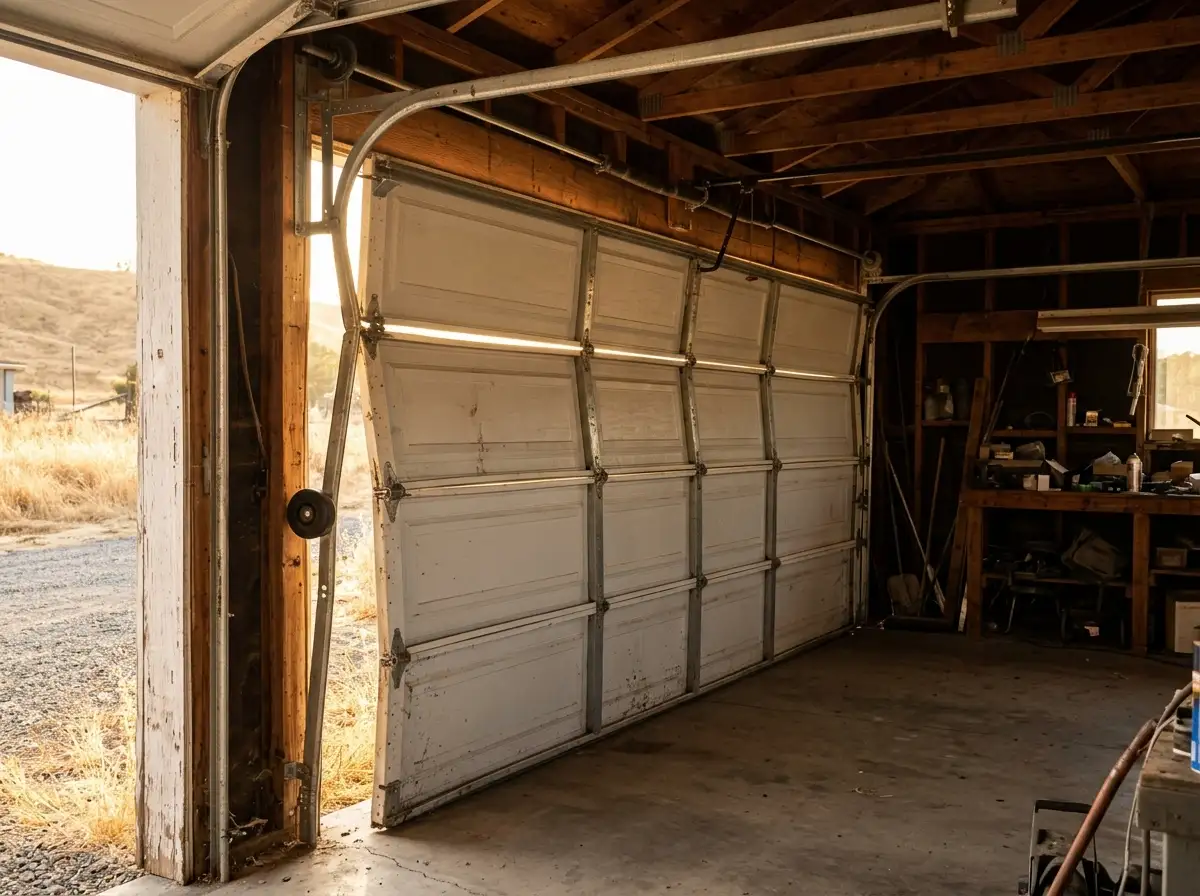
- A roller hanging in the air beside the track, or wedged against its outer lip.
- The door stopped at a slant, with a wedge of daylight down one side.
- A scrape, a pop and a jolt, then the opener straining or reversing.
- A track that is bowed, twisted or pulled away from the wall.
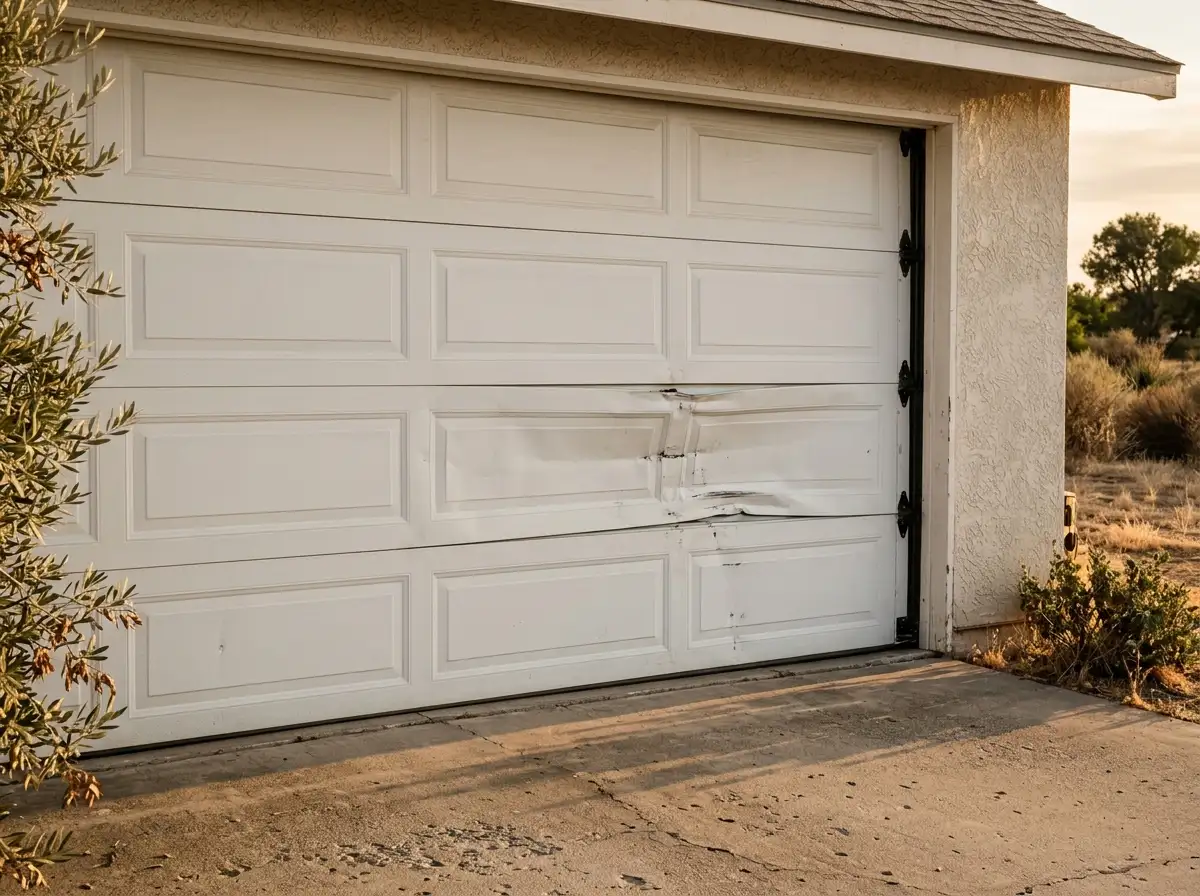
- A fresh crease across a section near one edge.
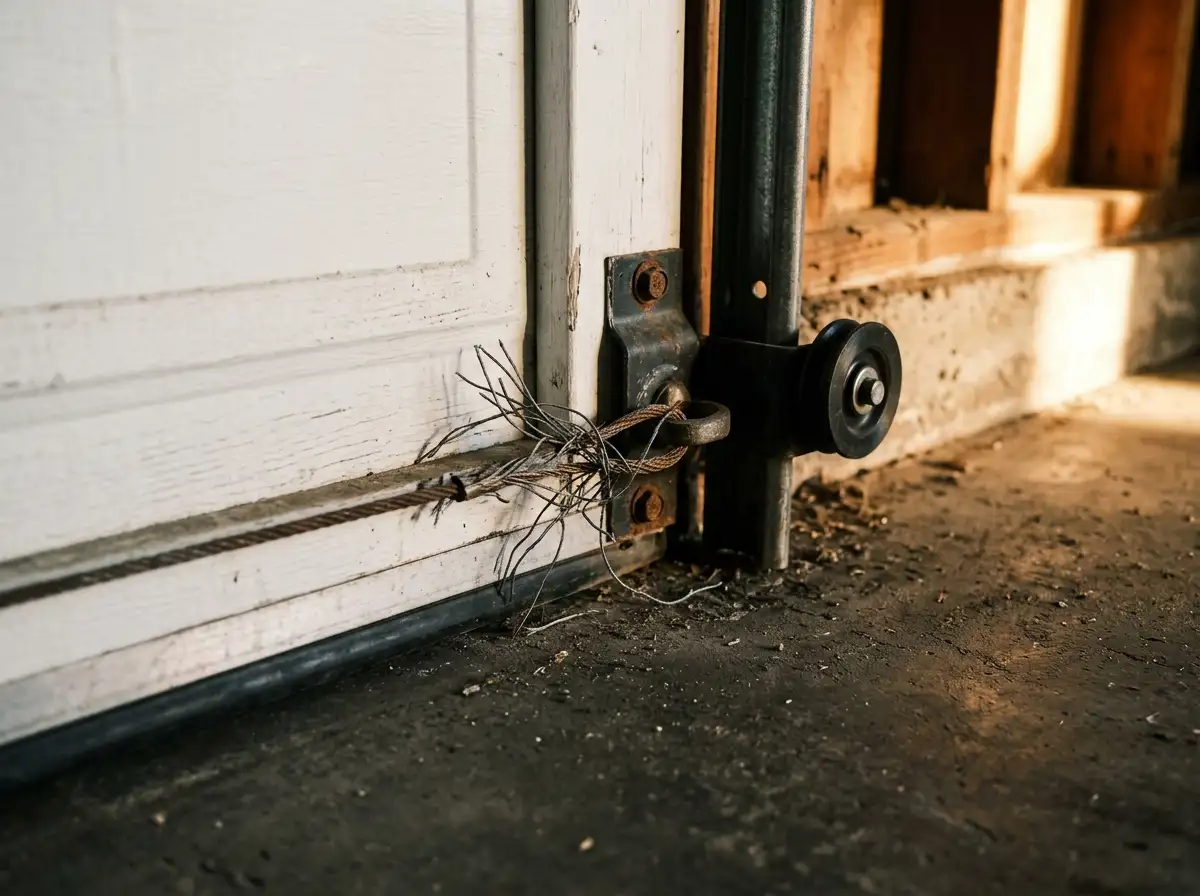
If a wire is also hanging slack at one side, the first failure was probably a cable. The cable repair page explains that half of the problem.
How the track and rollers keep a door in line
The track guides the door but does not carry it, and that explains most of what goes wrong.
Each side of the opening has a steel channel. It runs upright beside the door, curves at the top and continues level under the ceiling. Rollers, the small wheels along the door’s edges, ride inside it.
Each roller sits on a stem that slides into a hinge. The hinges join the sections so the door can bend around the curve. The upright track leans slightly away from the frame as it rises, and each hinge up the door holds its roller a little further out to follow that lean, which is why hinges carry position numbers.
The weight hangs from the lift cables and the springs above the door. So when a spring breaks or a cable lets go, the track is suddenly asked to hold a load it was never shaped for. Its lip spreads and a roller walks out.
The five things that push a roller out
Five causes account for most off-track doors, and the repair depends on which one it was.
- Impact. A car is the usual one. Even a slow nudge bends the upright track or kicks the bottom section sideways.
- A cable that came off or snapped. One side drops, the door twists in the opening and the rollers opposite are levered out.
- Worn rollers. A wheel with a failed bearing wobbles on its stem until the stem bends or the wheel breaks away.
- Loose track fasteners. The brackets holding the track to the wall work free over years of vibration, the track drifts wide and the gap lets a roller escape.
- Something in the track. A stone, a screw or a wad of leaves at the foot of the upright channel stops a roller while the opener keeps pushing.
What the technician does, in order
A proper off-track repair fixes the cause and then proves the door is balanced.
- Secures the door. Clamps on the track and support beneath the door stop it moving in either direction.
- Works out what failed first. The roller that is out is the result. The cause may be a cable, a spring, a bracket or a dent.
- Resets the rollers. The track is opened or eased where needed and each wheel is guided back in. Damaged rollers are changed at this point.
- Straightens or replaces the track. Minor bends are dressed out. A creased or twisted length is swapped for a new one.
- Checks the cables and drums. Both cables have to sit in their drum grooves and pull with even tension.
- Aligns both tracks. They are set plumb, parallel and at the same spacing from the door all the way up, then fastened tight.
- Runs the balance test. With the opener disconnected, the door is set halfway and released. It should hang there. Then the opener is reconnected and its reversal is checked.
When track or a section can be straightened, and when it must go
Steel that has bowed can be trued, and steel that has creased cannot.
| Part | Can be put right | Has to be replaced |
|---|---|---|
| Upright track | A shallow bend, a spread lip, a bracket pulled loose | A crease, twist or tear |
| Curved and level track | Knocked out of line but still true | Kinked at the curve, where rollers change direction |
| Rollers | Not repairable | Any with a wobble, a flat spot or a bent stem |
| Hinges | Loose ones retightened | Cracked or bent ones |
| Door section | A dent in the face with square edges | A crease across the full width, or a torn edge where a hinge mounts |
A creased section flexes every time the door rounds the curve and will not hold a hinge for long. If one has to go, the panel replacement page covers how a single section is matched.
Steel or nylon: which rollers go back in
Any roller with a bent stem or a wobble is replaced, and what goes back in is your choice.
A replacement has to match the old one in stem length and wheel size, or it will not sit properly in the hinge and the track. Beyond that the decision is about sound. Steel wheels are hard-wearing and loud, and nylon wheels on sealed bearings run quietly, which matters when a room shares a wall or a ceiling with the garage.
Changing every roller at once is worth doing when the old ones are worn. It is not a requirement of an off-track repair, and the tune-up page compares the roller types in full.
What an off-track repair costs
The bill follows the damage, which is the practical reason to stop early. Fixr, a national cost guide, puts off-track repair at about $100 to $300. HomeGuide’s 2026 figures give $200 to $350 for realigning a door and $125 to $300 where track is replaced.
Neither is a quote for your door. The technician prices the job on site, before starting, and the estimate is free.
The things that move it are the length of track that needs replacing, the number of rollers, whether a cable or spring failed too, and whether any section creased. A night or weekend visit usually costs more. Our repair cost guide lists the published ranges for each of those parts.
How to judge the repair afterward
A door that has been put back properly runs quietly, sits level and stays where you leave it.
- Rollers rubbing or clicking at one spot mean the door was pushed back into a track that is still bent.
- A door that binds halfway often means the track was tightened hard against the door to stop a roller escaping.
- An opener that now sounds strained may have had its force turned up to push through the tight spot. That hides the fault and weakens the safety reversal.
- No balance test means nobody checked whether a weak spring started all this.
Ask what the cause was. A clear answer is the sign of a real repair.
Keeping the door on its track
A few habits prevent most repeat calls.
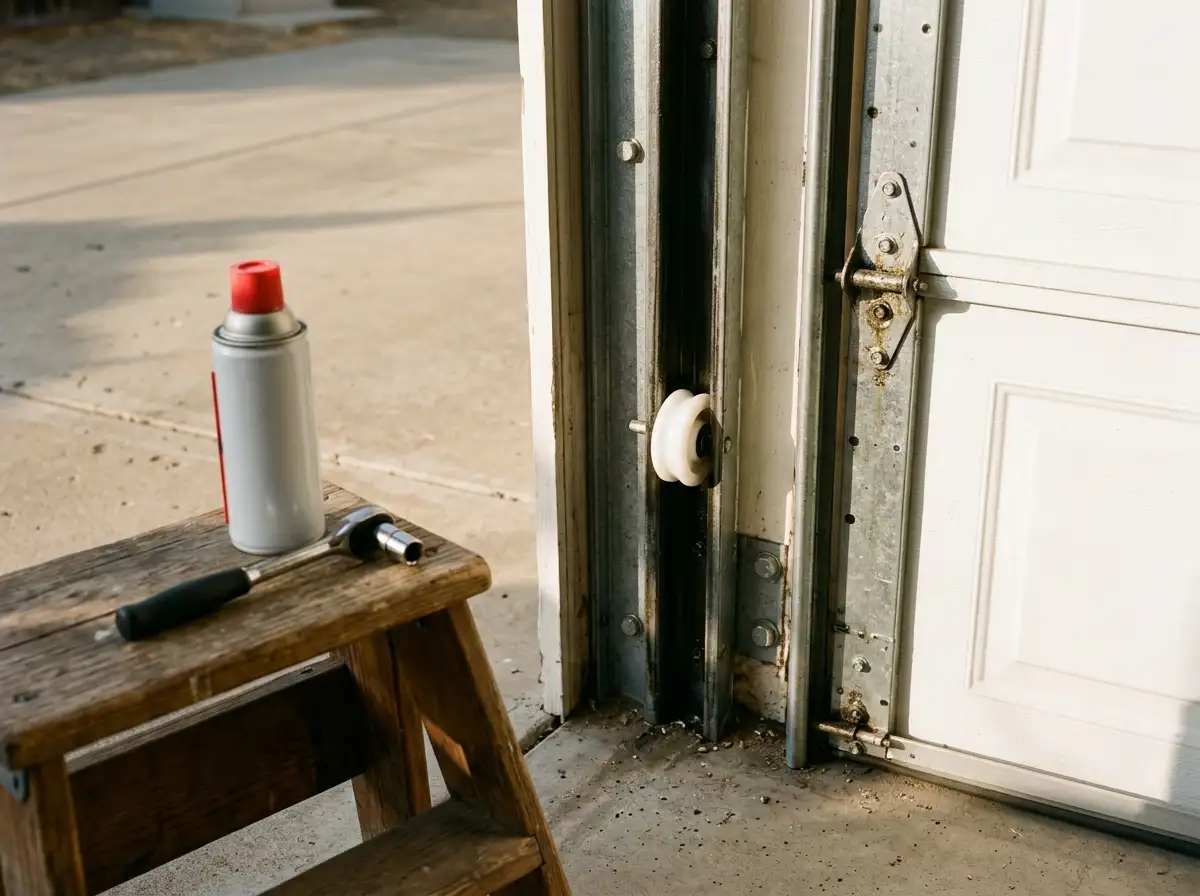
Spray the rollers and hinges with a garage door lubricant twice a year, and leave the track itself dry. Watch the wheels while the door moves: one that wobbles is on its way out. A pop at the same point of every cycle means the door is binding there.
Keep the opening clear before you press the button, and have the alignment checked once a year. If the door has been bumped, get it looked at even when it still seems to run.
Off-track doors around Sacramento
Two local situations make an off-track door more likely. In the Central City, where the City’s design standards say parking historically sat on the alleys, a garage that opens onto an alley leaves little room to turn. A bumper or a mirror can catch the door edge or the track.
On the older tree-lined streets, leaves and twigs collect at the foot of the upright tracks through autumn and after winter wind storms. Sweeping the doorway is worth the minute it takes.
Technicians cover the city and the towns around it, including Fair Oaks, Rancho Cordova and Roseville. A door jammed open after dark is covered on the emergency repair page.