Is the door one piece or in sections? If the whole thing is a single slab that kicks out at the bottom and swings up under the ceiling, it is a tilt-up door, and almost nothing written about sectional doors applies to it. Tilt-up garage door repair in Sacramento starts with someone who knows the difference, because the springs, the hardware and the risks are all its own.
How a one-piece door works
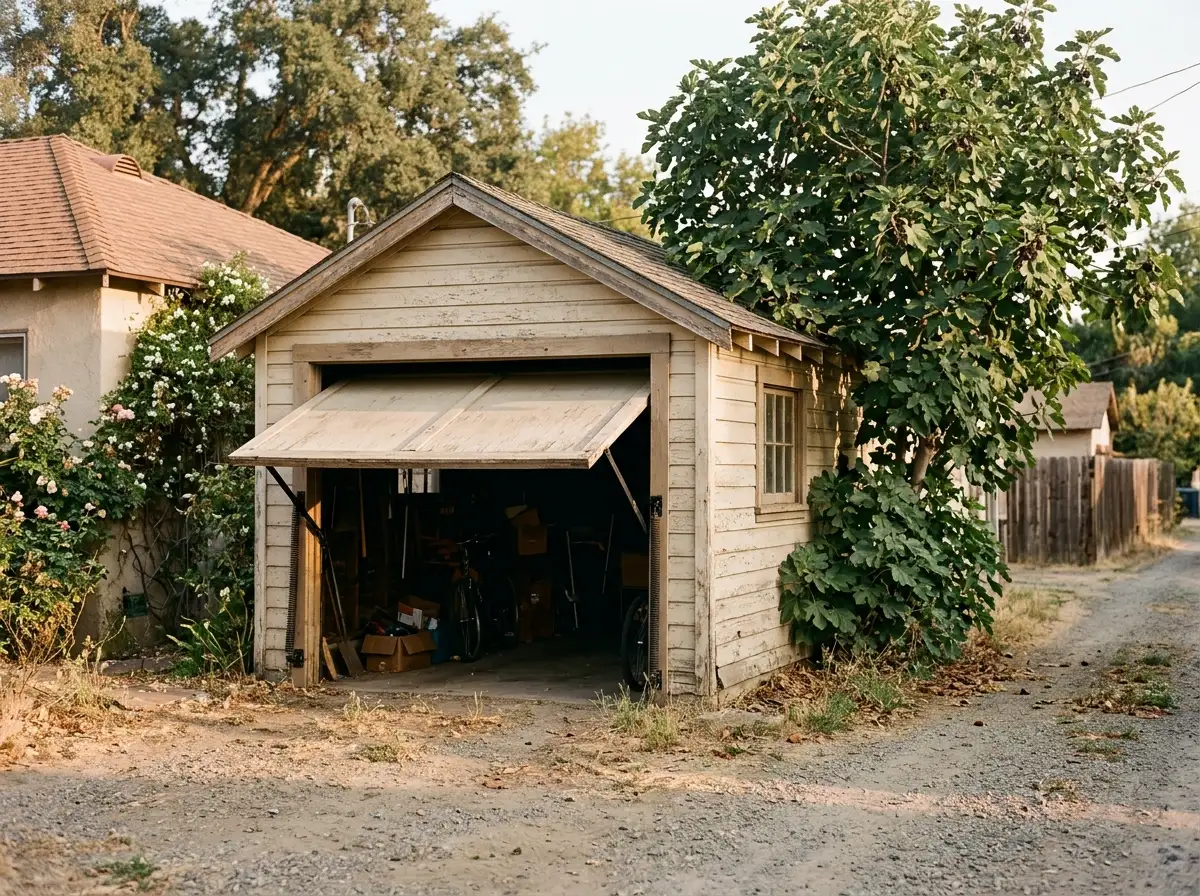
A one-piece door is a rigid panel hung on pivoting steel arms, with a heavy spring at each side carrying its weight.
There are no hinges across the face and no rollers climbing a curved track. Each side of the slab is bolted to a hardware set fixed to the jamb, the upright post at the edge of the opening.
A set is a mounting plate, two or more arms that turn on pins, and a long spring stretched alongside. Some versions add a short track under the ceiling with one roller at each top corner.
With the door shut, the springs are stretched to their longest and hold the door’s weight in reserve. As the door lifts, the arms swing the bottom edge outward and the springs pull the slab level overhead. The rule that governs every garage door holds here too: the springs do the lifting, and an opener only starts and stops the movement.
How it differs from a sectional door
Nearly every part has a different name, a different place and a different way of failing.
| Feature | One-piece (tilt-up) | Sectional |
|---|---|---|
| The door | One slab, often a wood frame with a plywood or steel face | Four or five sections joined by hinges |
| The path | Swings out in an arc, then lies flat overhead | Rises straight up and bends around a curved track |
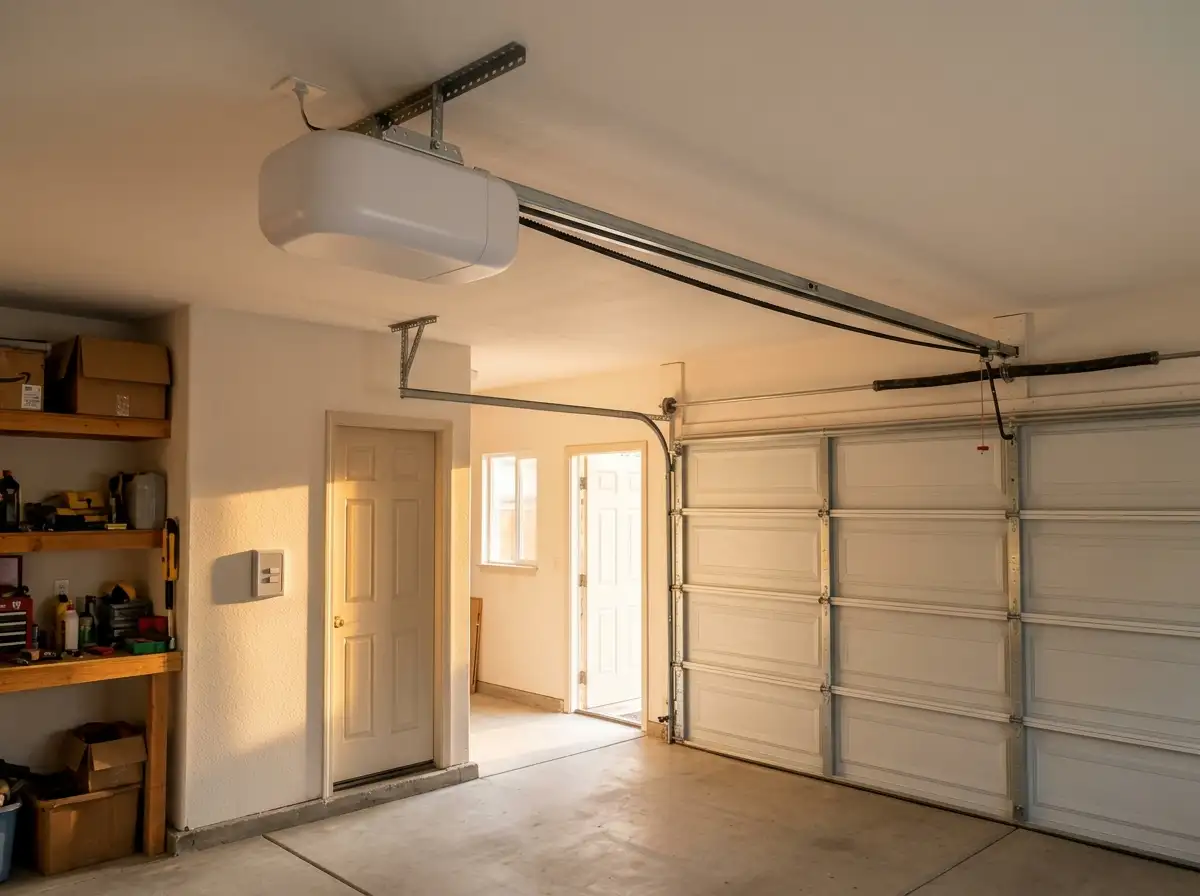
| The springs | Stretched at the sides, out in the open | Usually wound on a shaft above the opening |
| Space it needs | Clear driveway in front of the door | Headroom above the opening |
| Sealing | Closes against stops, hard to seal tightly | Sealed on all four edges |
| Parts | Old hardware sets can be hard to match | Common parts are widely stocked |
What fails on a one-piece door, and what each sign means
Most complaints trace back to the springs, the pivots or the slab itself.
- The door feels heavy, or drops over the last foot. The side springs have lost their pull. They weaken gradually with every cycle and are replaced as a matched pair.
- One side rises ahead of the other. One spring has broken or weakened, or a pivot has seized on one side. A twisting slab is a door to stop using.
- A bang, then a spring hanging slack. A side spring has broken.
- A clunk or a sideways shift as the door starts to move. The pivot pins have worn and the holes in the arms have gone oval.
- The door bows in the middle or a bottom corner drags. The slab is sagging. A wide wood door spends its open hours lying flat, held only at its two ends, and over the years the middle drops.
- Cracks around the hardware bolts. The frame of the slab is splitting where the load is carried.
- Hardware pulling away from the jamb. The wood behind the mounting plate is split or rotten.
- The opener strains and the top of the door flexes. The opener arm is wrong for a one-piece door, or it is fastened to the slab with no reinforcement behind it.
The door swings outward, and the springs are in the open
A one-piece door is dangerous in two ways a sectional is not: its bottom edge travels out into the driveway, and its springs sit unguarded at the sides.
The bottom of the slab moves outward before it moves up. A child on a bike, a car parked a little too close or a person walking up to the door is in its path. The arms at each side also close like a pair of shears as the door moves, and they are at hand height.
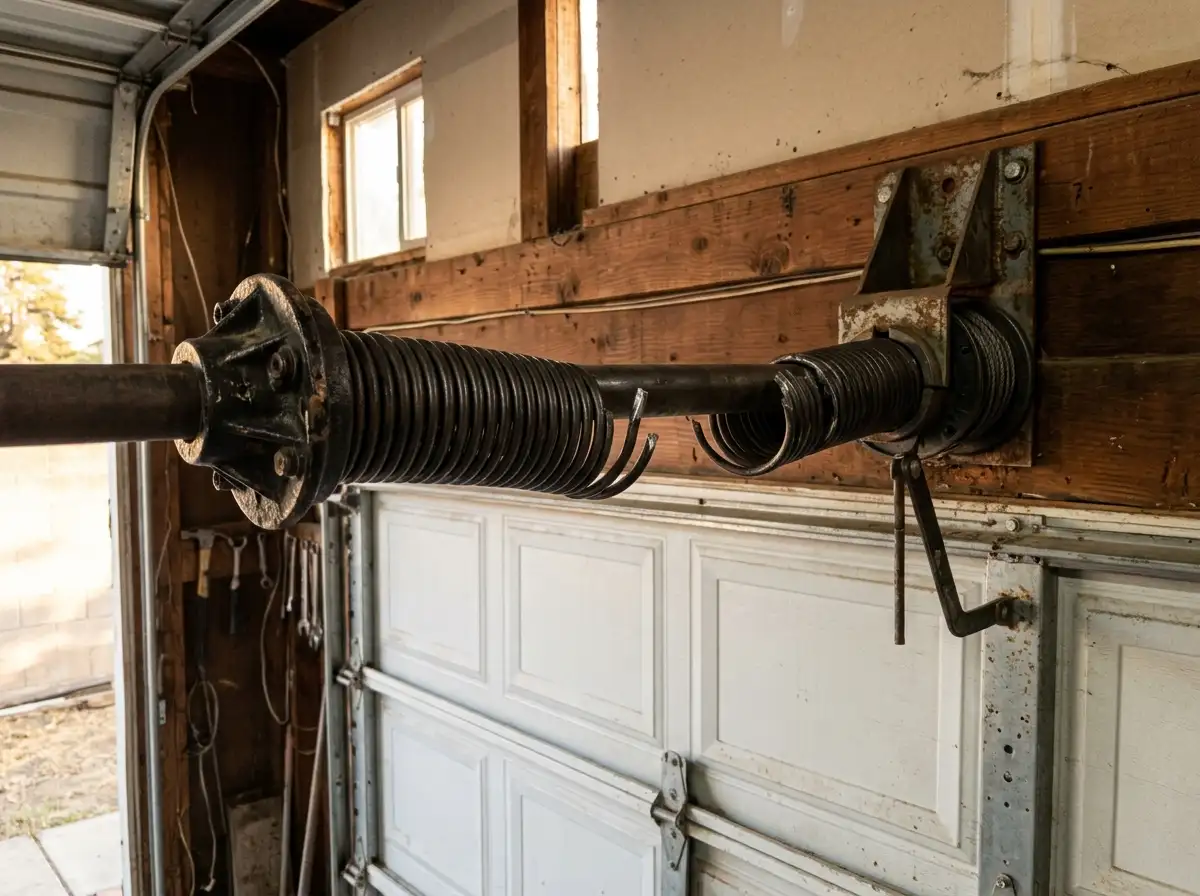
Then the springs. On many older sets nothing runs through the coil and nothing covers it. When a spring like that breaks, the pieces go wherever the stored force sends them.
Containment, a cable or rod through the spring that keeps a broken one in place, is a small addition and belongs on every door of this kind.
Leave the side springs alone. Do not unhook, shorten, move to another hole or replace a side spring yourself. It is stretched hard whenever the door is closed and still carries load when the door is open.
Do not prop a heavy door open with a board and walk under it either. If a spring has broken, leave the door where it is and call.
What a repair visit covers, in order
A good visit treats the door as one system and checks both sides, even when only one side is making the noise.
- Works the door by hand. With any opener disconnected, the technician lifts and lowers the door and watches whether both sides move together.
- Checks the slab. Frame joints, cracks at the hardware bolts, rot along the bottom rail and how far the middle has dropped.
- Checks the hardware. Pins, arms, mounting plates and the fasteners into the jamb, plus the jamb wood behind them.
- Gives you the price. What has failed, what is close behind it and what the choices are.
- Replaces the springs as a pair. They are sized to the weight of the slab, and containment is fitted if the door has none.
- Stiffens the slab if it needs it. A steel brace or tension rod across the back takes the bow out of a sound door.
- Sets the balance. The door should hold partway and should not slam at either end of its travel.
- Sets up the opener. Arm, travel and force for a one-piece door, then the reversal test and the sensor beam.
If the cause turns out to be the springs alone, the job is close to a standard spring replacement, with different springs.
Repair it, or convert to a sectional door
Repair a sound slab. Think about converting when the slab, the hardware or the driveway is working against you.
| Your situation | Repair | Convert |
|---|---|---|
| Slab solid, hardware tight, springs tired | Yes: a new matched pair and containment | Not needed |
| Pivot hardware worn and no longer made | Only with a full new hardware set | Often the better spend |
| Slab cracked, rotted or badly sagged | Possible with a new slab | Price both |
| Short driveway, or the door opens onto an alley or sidewalk | The outward swing stays | A sectional rises inside the opening |
| You want insulation, tight seals or a quiet opener | Limited | Yes |
| Historic district or design rules apply | Like for like is the simpler route | Check the rules first |
For scale, HomeGuide’s 2026 cost guide puts replacing the single panel of a tilt-up door at $400 to $1,000 or more, and Fixr puts extension spring replacement at $120 to $250. Those are published national figures and not our prices. The technician quotes the real number on site, and the estimate is free.
What moves the figure: the size and weight of the slab, whether the hardware comes as a full set, the state of the jamb wood, and whether an opener is involved.
What a conversion involves
A conversion is a new door installation in an opening that was never built for tracks.
The old slab and its hardware come off first. Then the opening is measured for three things a one-piece door never needed: headroom above for the curved track and spring shaft, room at each side for the vertical tracks, and solid framing to fasten it all to. Standard track wants about a foot above the opening, and low-headroom hardware exists for garages with less.
Jambs and the header often need new lumber or trim before a sectional will seal against them. After that the tracks, the torsion spring and the door go in, and the door is balanced.
The opener usually changes too. California Health and Safety Code section 19892 says any residential opener installed since July 1, 2019 must have battery backup. It also says a replacement door may not be connected to an existing opener that lacks it. So a conversion normally includes a new opener.
On permits, ask the building department before work is booked. Widening the opening or running new wiring changes the answer.
Keeping an old one-piece door going
Paint and lubricant do most of it. The rest is watching.
Keep the slab painted, above all the bottom rail and the top edge, where water gets into the end grain. Spray the pivot points with a garage-door lubricant twice a year. Once a month, look at both springs with the door closed: the coils should be evenly spaced, with no gap and no kink.
If the door has an opener, lay a length of 2x4 flat in its path each month and close the door on it. The door must reverse when it touches the wood.
One-piece doors in Sacramento: old garages and design rules
Census housing counts put about four in ten homes in the city as built before 1970, and a garage of that age is where a one-piece door is most likely to survive.
The City’s design standards say parking in the Central City historically sat on the alleys. If your garage opens onto one, the door swings into the lane, which is worth weighing in the repair or convert question.
Design rules matter before you change the look of the door:
- Historic districts and landmarks. The City’s exemption form for doors on historic properties, CDD-0033, covers like-for-like work. Anything outside its checkboxes needs a Preservation application approved before work starts. Planning staff ask for a scope of work and photos first.
- The South Land Park Hills Eichler district. Its plan says to keep and repair the original vertical-groove doors where feasible, or use a plain flat door, and rules out raised-panel traditional styles facing the street.
- Folsom. The Historic District handout allows one-piece door styles only in the 1950s and 60s Persifer-Dean subarea. Our Folsom page has more.
The same service reaches Carmichael, Rancho Cordova, Citrus Heights and West Sacramento. Say that the door is one piece when you call, so the technician knows what to bring.