When you press the button, what happens: nothing at all, a hum, or a click and a light with no movement? Each answer points at a different part, and some of them are not the opener. Garage door opener repair in Sacramento starts with that question, and quite often it ends with a check you can make yourself.
Five checks to make before anyone comes out
Most openers that look dead have lost their power, lost their signal or been disconnected from the door. These five checks are safe for anyone and need no tools.
- The remote battery. If the wall button works and the remote does not, start here. Try the button built into the car as well.
- The lock switch on the wall button. Many wall controls have a lock or vacation switch that turns off every remote at once. It gets pressed by a broom handle or a curious child, and nothing looks wrong afterward.
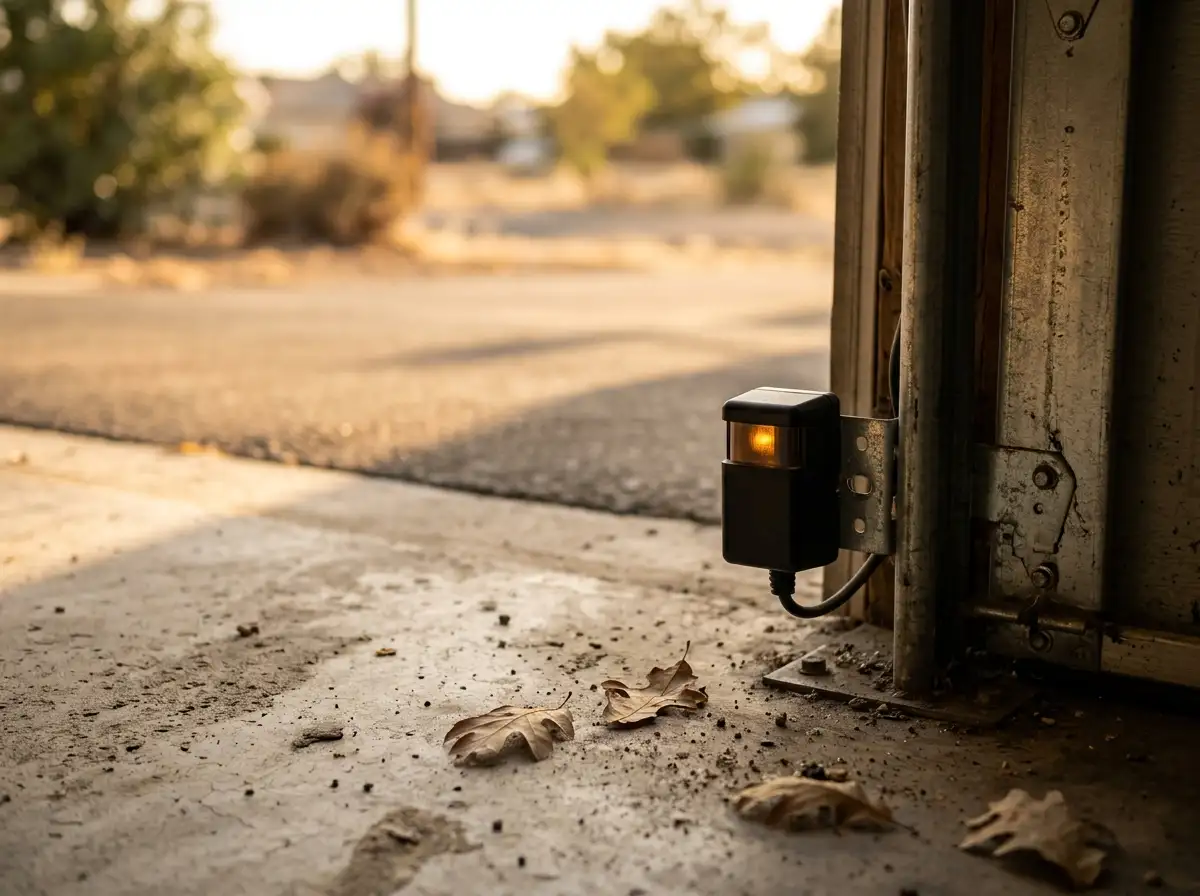
- The photo-eyes, the two small sensors near the floor. Wipe both lenses, move anything leaning near them and see that each little light is steady. If the door refuses to close, holding the wall button down will usually close it once.
- The power. No lights and no sound means no electricity. See that the unit is still plugged in, press reset on the GFCI outlet (the one with the test button) and look at the breaker panel.
- The red release cord. If the motor runs and the chain or belt travels but the door stays put, someone has pulled the cord and disconnected the door. With the door fully closed, run the opener and the carriage will usually click back into place.
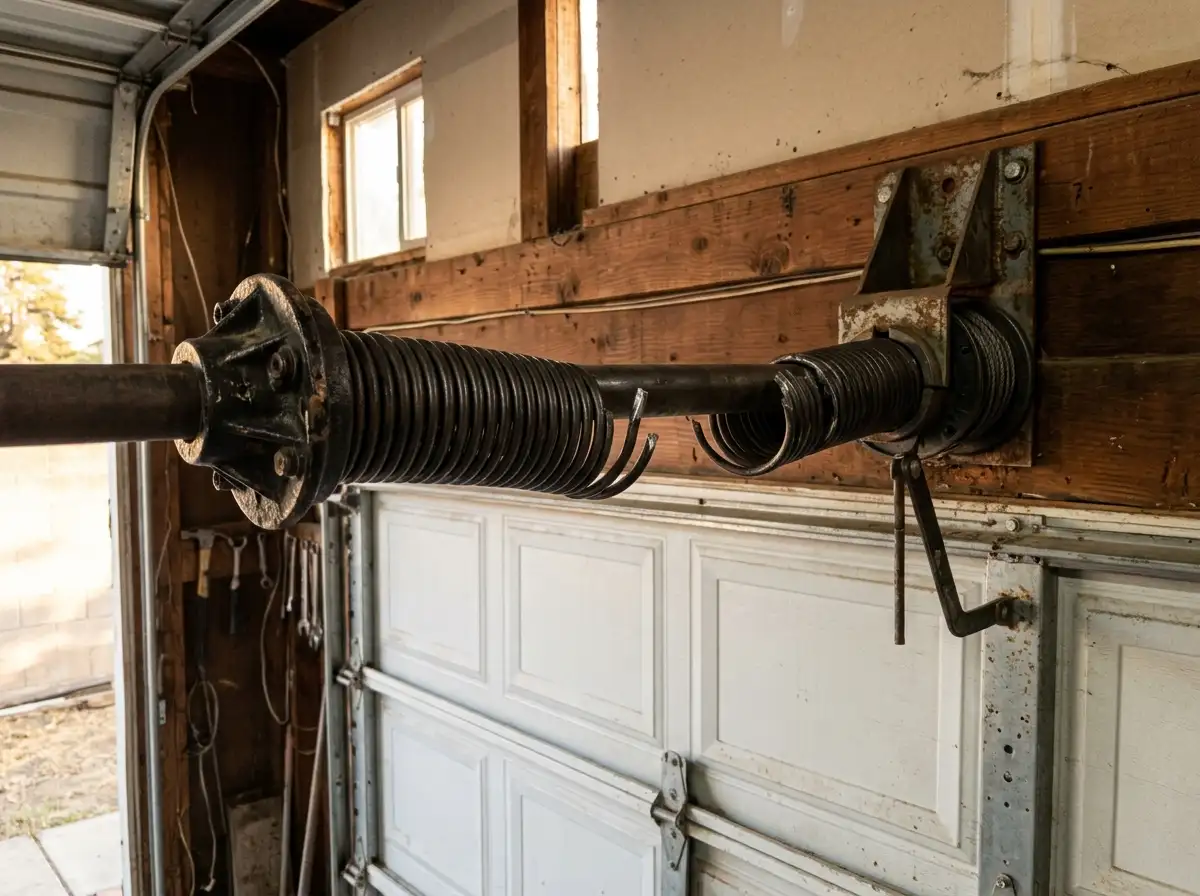
If the door felt heavy when you moved it by hand, stop there. That is a spring, and the spring repair page explains why the opener should not be run again.
What each symptom usually means
The way an opener fails narrows the fault to one or two parts.
| What you notice | Most likely cause | First move |
|---|---|---|
| A short hum, no movement | Worn start capacitor, or a broken spring pinning the door | Look at the spring, then call |
| Motor runs, nothing travels, white plastic dust below the unit | Stripped drive gear | Call |
| Motor runs, chain moves, door stays | Carriage released by the red cord, or broken | Re-engage it with the door closed |
| Door stops short of the floor or the top | Travel limits have drifted | Call |
| Door touches the floor and comes back up | Close limit or force setting, or the photo-eyes | Check the eyes |
| Remotes will not program, lights act strangely | Logic board | Call |
| Runs early, quits by afternoon | Motor overheating, or sun in a photo-eye | Shade the eye to test |
| Completely dead | No power, or a failed board | Check outlet and breaker |
A blinking light on the unit or the wall button is a code, and codes differ from one brand and model to the next. Count the blinks and tell the technician, and do not rely on a chart written for a different opener.
When the trouble is only at closing time, the sensor repair page goes further. Our guide to a garage door that will not open covers the other direction.
What is inside the box on the ceiling
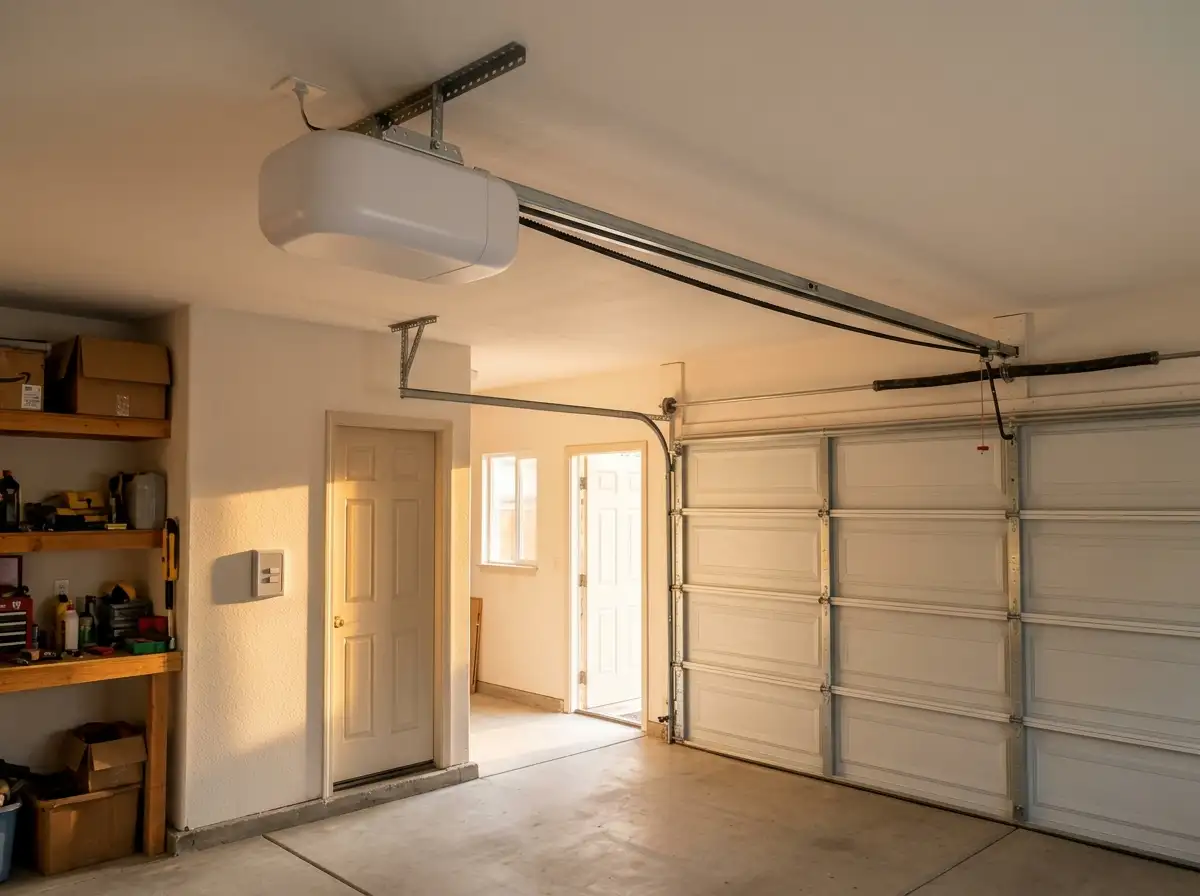
An opener is a small motor, a reduction gear, a circuit board and a rail, and each fails in its own way.
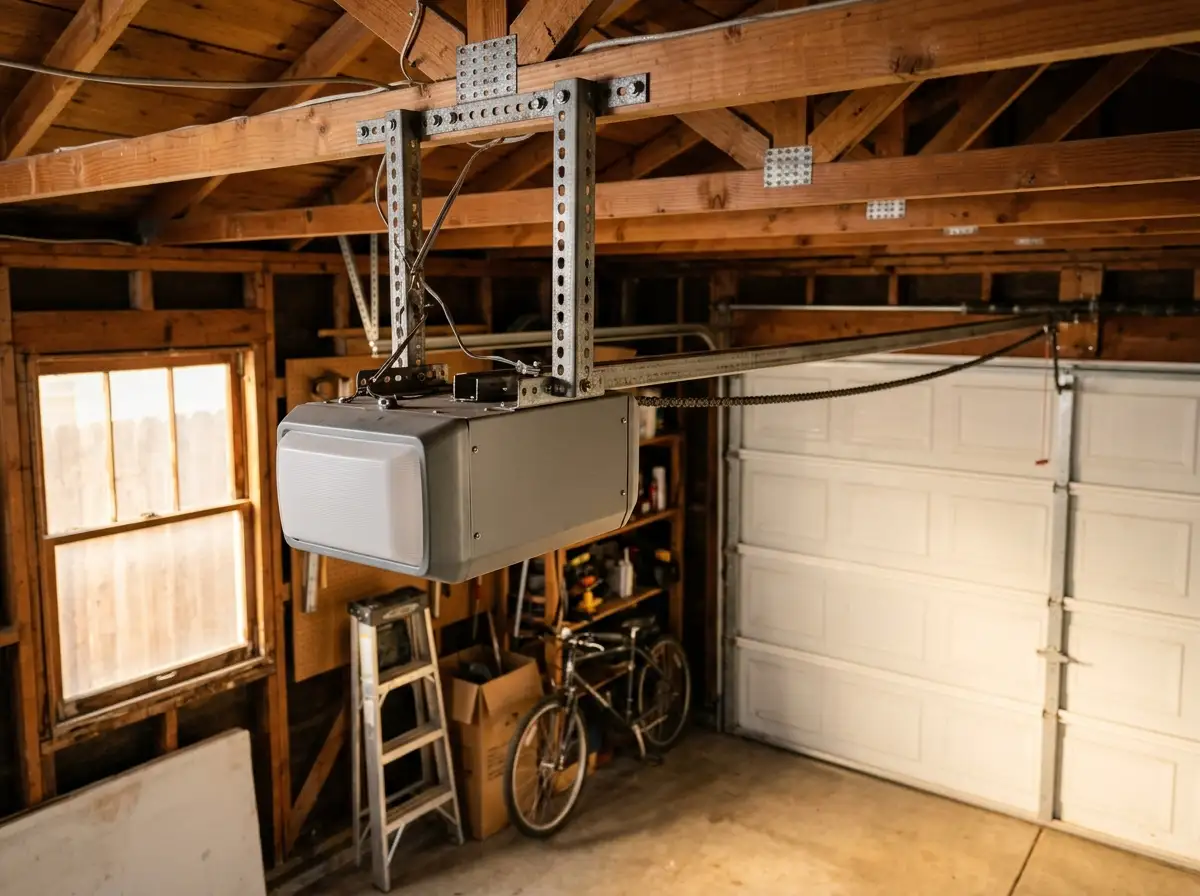
The motor turns a gear, and the gear drives a chain, a belt or a threaded rod along the rail. A carriage, which the trade calls the trolley, rides that rail and is joined to the top of the door by a metal arm. The circuit board, known as the logic board, listens for the remotes, watches the photo-eyes and decides where the door stops and how hard it may push.
Older units have an AC motor with a start capacitor, a small can that gives the motor its first kick. Newer ones have a DC motor that starts and stops gently and can run from a battery. In many ceiling units the main drive gear is nylon, and it is the part that gives way when the door gets heavy.
Why openers fail, and why the door is often to blame
An opener is built to move a door that the springs have already made close to weightless. When the springs tire, the opener inherits the load and its parts wear out far sooner.
- A heavy door. The motor works harder on every cycle. The nylon gear strips, the capacitor weakens and the top section of the door starts to flex where the arm bolts on.
- Surges. Lightning, and the flicker as power returns after an outage, are what kill logic boards.
- Drift. Travel and force settings move as the door and its hardware wear, so a door that once sealed now stops an inch high or bounces off the concrete.
- Age. Capacitors dry out, plastic turns brittle and chains stretch until they slap the rail.
This is why a new gear fitted without a balance check is half a repair. It meets the same load that destroyed the old one.
Why an opener quits on a hot afternoon
Heat is the reason an opener can work at seven in the morning and refuse at four. It is a familiar summer pattern in Sacramento.
The city averages 76 days a year at 90 degrees or more and 14 at 100 or more, and a closed garage runs hotter than the street. Older motors carry a thermal cutout that switches them off when they overheat and lets them run once they have cooled. A weak capacitor and an aging board are at their worst in the same heat, and remotes often lose range.
Two things to try. Let the unit cool and press the button again later.
If the door will not close in late afternoon, shade the receiving photo-eye with your hand, because low sun shining into it reads as an obstruction. An opener that keeps cutting out needs a look all the same: a motor that overheats is usually pulling too much weight.
Winter has its own version. After a storm outage an opener can come back to a tripped GFCI outlet, or with a board damaged by the surge. All of this holds from Natomas out to Roseville and Elk Grove.
What the technician does, in order
A proper opener repair starts at the door and works back to the motor.
- Disconnects the opener and moves the door by hand. A door that sinks when it is let go halfway has a spring problem, and that is dealt with first.
- Checks power and wiring. The outlet, the thin wires to the wall button and the photo-eyes, and the terminals on the unit.
- Opens the housing. Drive gear and sprocket, capacitor, board, then the rail, the chain or belt and the carriage.
- Tells you what failed and what it costs. You choose between repairing and replacing before any part goes in.
- Fits the part, then sets the travel limits and the force for your door.
- Runs the safety tests. The door must reverse off a piece of 2x4 laid flat on the floor, and again when something crosses the photo-eye beam.
If your own checks changed nothing, this is the point to call. A licensed technician comes out the same day in most cases, and the estimate is free.
Repair it or replace it
Repair an opener when one part failed and the rest is sound. Replace it when the repair costs close to a new unit, or when the opener predates today’s safety features.
Worth repairing
- A stripped gear or tired capacitor on a unit with years left
- Limits or force settings that have drifted
- A broken carriage, a stretched chain, a worn belt
- Remotes, keypads and wall buttons
- Photo-eyes or their wiring
Time to replace
- No photo-eyes at all, which dates it before 1993
- Remotes set with rows of tiny switches
- A dead board on a model whose parts are no longer made
- You want it quiet, on your phone, or working through a power cut
Openers commonly run for a decade or two. On a unit toward the far end of that, weigh any board or motor repair against the price of a new unit.
California’s battery backup rule. Under Health and Safety Code section 19892, a residential opener sold or installed in California since July 1, 2019 must have a battery backup that works in an outage. Nothing in it makes you retire a working opener, and repairing yours is fine. If it is replaced, the new one has to carry the battery.
The opener installation page sets out the drive types and what fitting a new unit involves.
What an opener repair costs
The failed part decides the bill. Fixr, in figures updated January 31, 2025, puts opener repair at $100 to $300 nationally and a replacement circuit board at $150 to $400. HomeGuide’s 2026 guide gives $100 to $200 for a typical opener repair.
These are published national ranges and not a price list. The technician quotes the real figure on site.
What moves it: which part failed, whether it is still made for your model, the brand, and whether the door needs work before the opener can be trusted with it. A night or weekend visit usually costs more.
How an opener repair goes wrong
Bad opener work has a signature: the symptom goes away and the cause stays.
- Force turned up to hide a heavy door. The door moves again, but it now pushes hard enough to hurt someone and fails the reversal test.
- A new gear on an unbalanced door. It strips again, and sooner than the first one did.
- Limits set and never tested. The door closes without sealing, or hits the floor and bounces back open.
- Photo-eyes taped together up on the ceiling. This defeats the device that stops a door closing on a child or a pet. If your sensors are not near the floor, facing each other across the opening, have that corrected.
Keeping the opener out of trouble
The kindest thing you can do for an opener is keep the door light.
Have the balance checked once a year, spray the rollers and hinges with a garage-door lubricant twice a year, and wipe the photo-eye lenses when you sweep. Once a month, close the door on a 2x4 laid flat and confirm it reverses. And when the opener starts to sound slower or more strained than it used to, treat that as the early warning it is.
Two area pages take this repair further: Citrus Heights on openers old enough to have no safety sensors, and El Dorado Hills on keeping the backup battery ready for a power shutoff.