What is above your garage: a bedroom, an attic full of boxes, or a ceiling low enough to touch? That one answer chooses most of the opener for you. The drive type follows from who has to listen to it, and the mounting follows from how much room there is overhead.
Garage door opener installation in Sacramento also comes with one decision the state has already made, so start there.
California has already chosen one feature for you
Every new opener fitted in California has a backup battery. It is the law, and locally it is also the feature most likely to be used.
Health and Safety Code section 19892. Since July 1, 2019, no residential automatic garage door opener may be sold or installed in California unless it has a battery backup designed to work during an electrical outage. A model without one cannot legally be fitted, whatever it costs elsewhere.
SMUD describes the wildfire risk in its own service area as low, so fire shutoffs are not the main worry here. The outages that reach garages come from wind and heat. The utility counted 599,000 customer outages across the January 2023 storms, and one wind storm on February 4, 2024 put about 200,000 out at once.
With a charged battery the door opens from the remote as usual through an outage like those. Without one you are on the red release cord, which our guide to opening a door by hand covers.
Chain, belt, screw, direct or wall-mount
The drive is the part that carries the motor’s turning to the door. Five designs are sold, and they differ mainly in noise and in where they sit.
| Drive | How it moves the door | Sound | Suits |
|---|---|---|---|
| Chain | A steel chain pulls the carriage along a ceiling rail | Loudest | Detached garages, tight budgets |
| Belt | A reinforced rubber belt does the same job | Quiet | Rooms above or beside the garage |
| Screw | A threaded rod turns and the carriage rides it | Moderate | Fewer moving parts, but sensitive to temperature swings |
| Direct | The motor itself travels along a fixed chain | Very quiet | Households that want the least noise from a ceiling unit |
| Wall-mount | A unit beside the door turns the spring shaft, with no rail | Quiet | Low, high or cluttered ceilings |
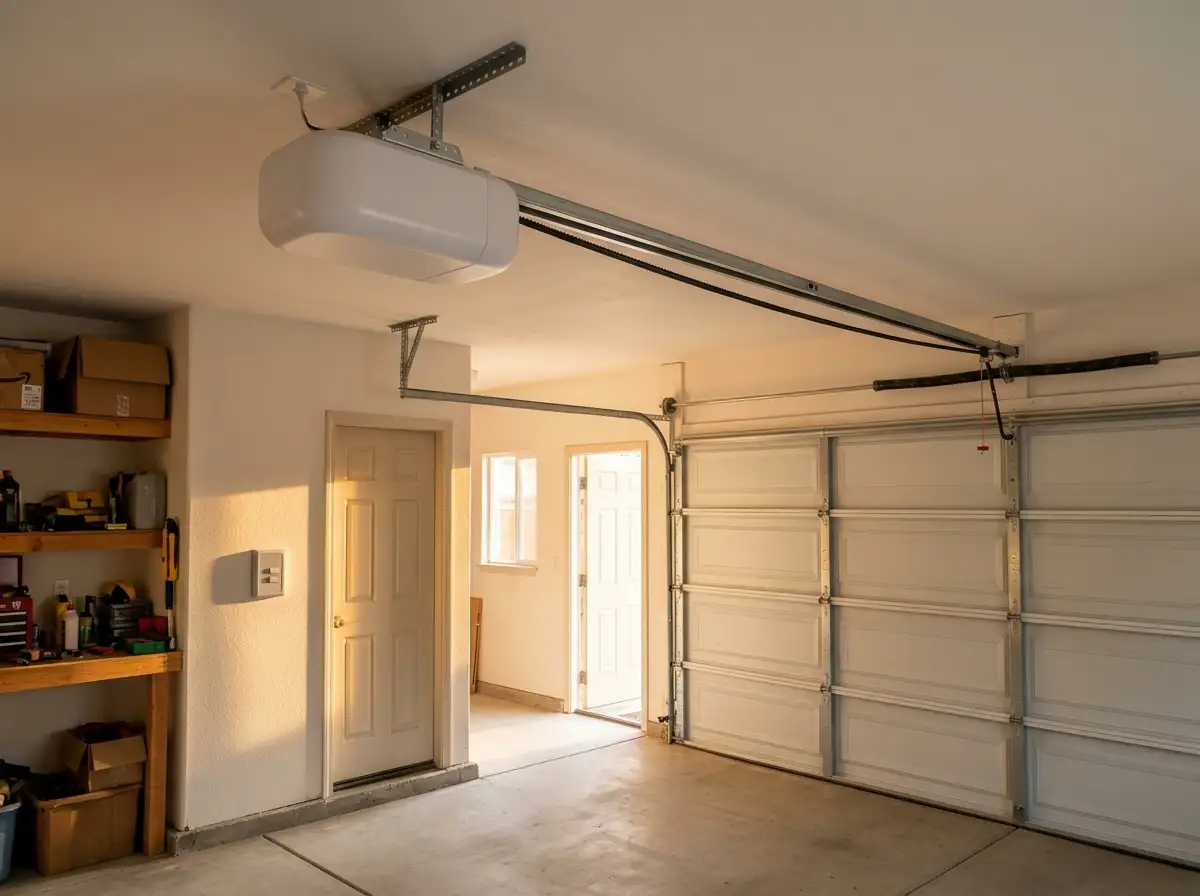
A chain drive bolted to joists under a bedroom sends a rumble through the floor every time someone leaves early. A belt drive, with nylon rollers on the door, is what removes it.
How much motor a door needs
Less than the box suggests. A balanced door asks the motor for a push, and nothing like a lift.
Power is sold as horsepower, or as an equivalent figure on DC units. The standard size moves an ordinary steel door, single or double, because the springs are carrying the weight. A solid wood door or an oversized one earns a step up.
What matters more is the kind of motor. A DC motor starts and stops gently, runs quieter and is what makes battery backup possible. An AC motor is the older design, simple and loud at the start of each cycle.
No motor makes up for a door that is out of balance. If the present opener died young, the door is tested before a new one is fitted, and a tired spring is dealt with first. Otherwise the new unit inherits the fault that finished the old one.
When the ceiling is low, high or in the way
A wall-mount opener, also called a jackshaft or side-mount, is the answer when a rail across the ceiling will not work.
It bolts to the wall beside the door and turns the torsion shaft, the steel bar above the opening that the spring sits on. That frees the ceiling for storage, clears a low beam and follows high-lift tracks up a tall wall. It needs a torsion spring system, some clear wall beside the door and an outlet within reach, and it is usually fitted with a monitor that stops it if a cable goes slack.
Our guide to side-mount openers goes through when one is worth the extra cost. One-piece doors are a separate case with their own arm, and the tilt-up door page explains them.
Smart features: which earn their place
An app is worth having if you have ever driven back to check the door. The rest is preference.
- Wi-Fi and an app. Open, close and check the door from your phone, and get an alert when it moves. Chamberlain and LiftMaster use myQ, and Genie uses Aladdin Connect.
- Scheduled closing. The door shuts itself at a set hour if someone forgot.
- A camera in the unit. Useful if deliveries are left in the garage.
- Rolling-code remotes. Standard for decades. An opener old enough to be set with rows of tiny switches has none of this and is due for retirement.
- A wireless keypad outside. Still the simplest way to let in a child who has lost a key.
What installation includes, in order
Fitting an opener is half assembly and half adjustment. The adjustment is the part that keeps people safe.
- Tests the door. Disconnected and lifted halfway, it should stay where it is left. If it drops, the springs come first.
- Removes the old unit and checks the framing it hung from.
- Mounts the header bracket above the door and assembles the rail.
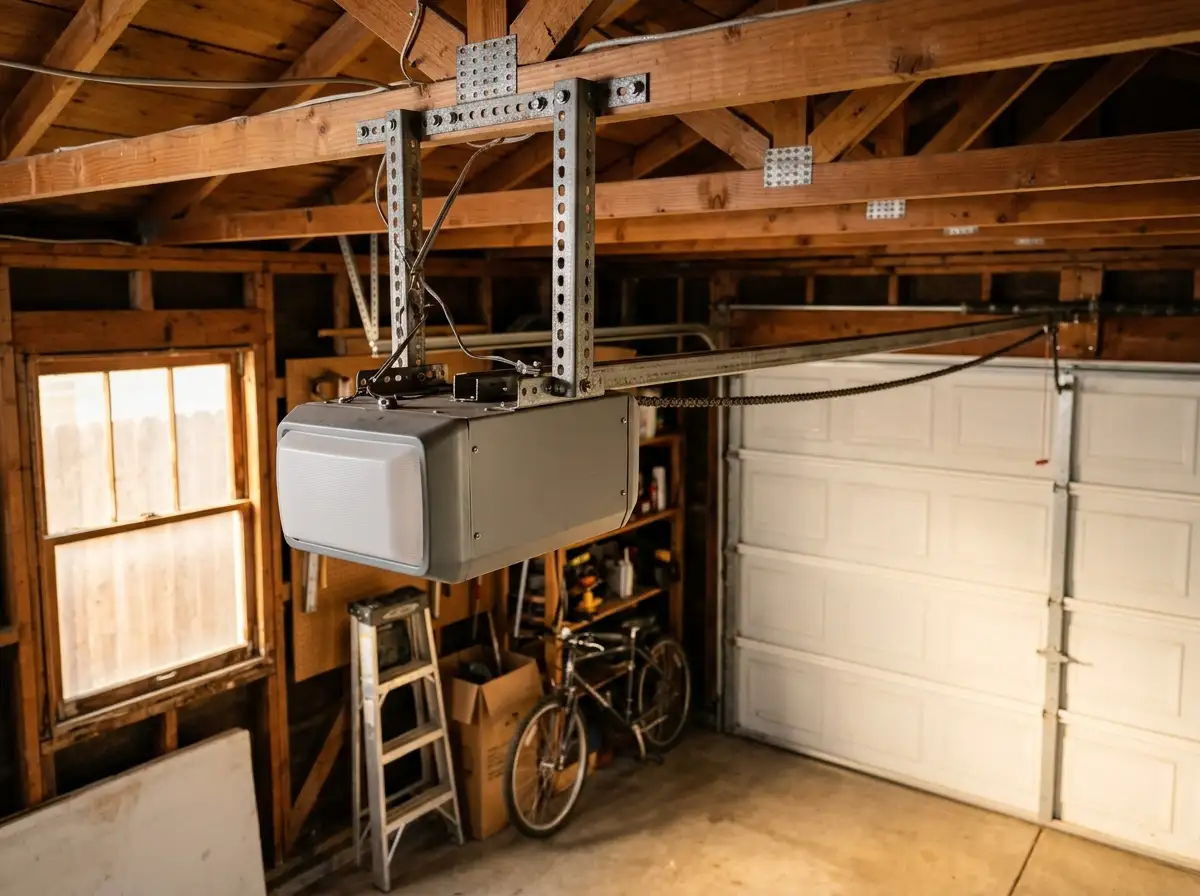
- Hangs the motor from the ceiling framing on rigid steel angle, level and square to the door.
- Fits the arm to a reinforced top section. A bracket and strut spread the pull so the door does not crease.
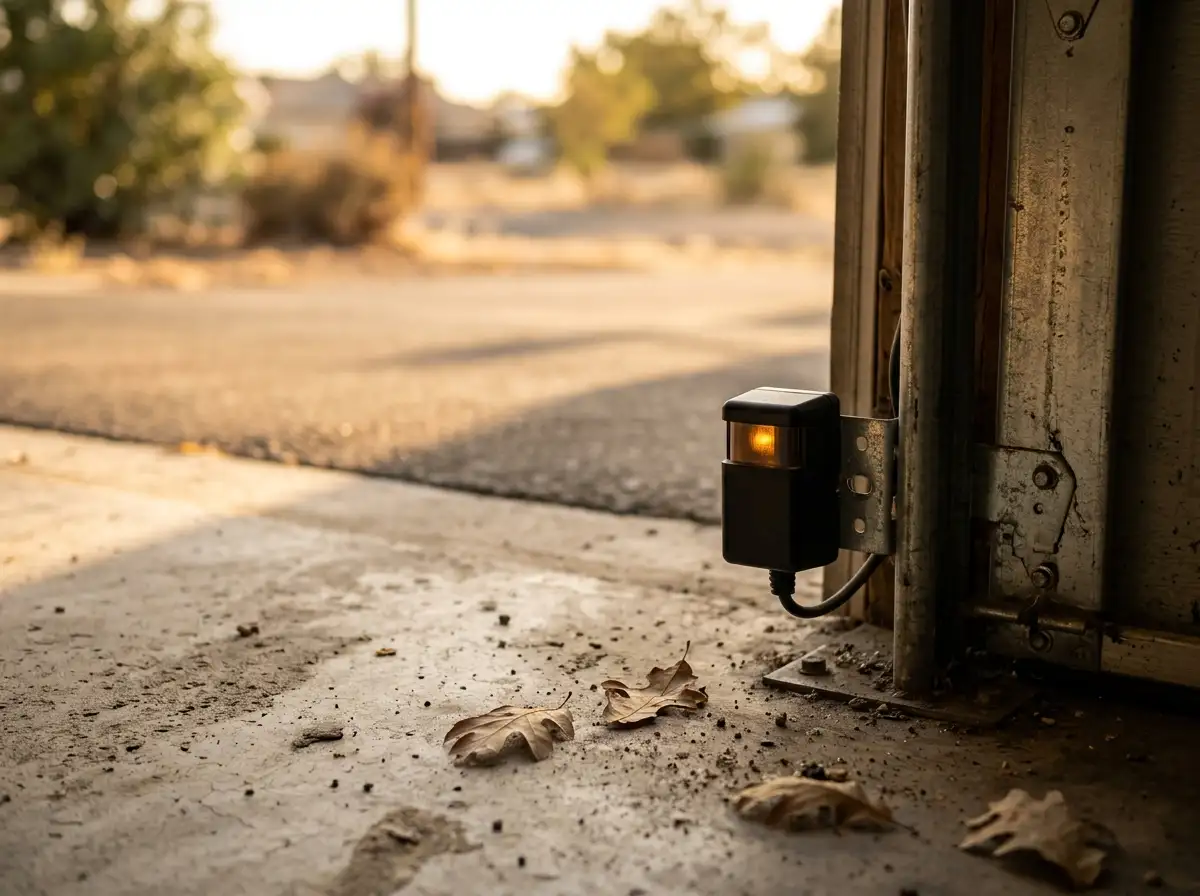
- Mounts and wires the photo-eyes, the two sensors that face each other no more than six inches above the floor.
- Wires the wall control and programs the remotes, the keypad and the car buttons.
- Sets travel and force. Where the door stops at each end, and how hard it may push before it gives up.
- Runs both reversal tests, against a board flat on the floor and against an object passed through the beam, then checks the battery takes over when the unit is unplugged.
A ceiling opener needs a grounded outlet near the motor. If there is none, adding an outlet or a circuit is electrical work, and a new circuit is the kind of job that appears on city permit lists. Ask your building department before it is run.
What a new opener costs installed
The unit sets most of the price and the garage sets the rest. HomeGuide’s 2026 guide puts a new opener at $300 to $900 installed, and Fixr, in figures updated January 31, 2025, gives $300 to $940 for an opener replacement.
Both are national ranges and not our prices. The technician quotes on site, and the estimate is free.
What moves it: belt and wall-mount units cost more than chain, a camera or extra remotes add to it, a taller door needs a longer rail, and a missing outlet or a door that needs balancing is separate work.
Replace now, or repair the one you have
If one part failed on a sound unit, repair is usually the cheaper answer. If the opener lacks photo-eyes or its board has died, put the money toward a new one.
Keep and repair
- The fault is a gear, a capacitor or the sensors
- Parts are still made for the model
- It already has a battery and a rolling code
- The noise does not bother anyone
Replace
- It has no safety sensors near the floor
- The circuit board failed on an old unit
- You are fitting a new door and the opener has no battery
- You want it quiet, or on your phone
The opener repair page lists what fails and what each fault looks like. And if a new door is planned as well, do both together, since state law will not let a replacement door be joined to an opener without backup.
How an opener installation goes wrong
A badly fitted opener works on the day and causes trouble later.
- Hung on perforated strap alone. The motor sways, the rail flexes and the noise grows month by month.
- Arm bolted to an unreinforced top section. The steel cracks around the bolts.
- Force set high so a heavy door will move. The door stops reversing when it should.
- Photo-eyes mounted high or aimed loosely. The door closes on things it should have seen, or refuses to close when the sun moves.
- Rail too short for the door. The door never opens fully and the carriage hits its stop.
Ask to watch the board test before the technician leaves. It takes a minute and tells you the force was set, not guessed.
What Sacramento garages add to the choice
Three local conditions tilt the decision, and each one points at a particular kind of opener.
Older neighborhoods come first. In the 95818 ZIP code, which takes in Land Park and Curtis Park, the median year built is 1942. Garages of that age can have little headroom, which is where a wall-mount unit earns its place.
Newer tracts are the opposite case. Where a two-story house from the 2000s in Natomas or Elk Grove has a bedroom over the garage, a belt drive is the one to fit.
Then there is heat. With 76 days a year at 90 degrees or more, ask how the motor is rated for repeated use, and keep stored boxes clear of the unit so it can shed heat. The same advice holds in Roseville and the towns east of it.
Making a new opener last
An opener lasts as long as the door stays easy to move.
Have the balance checked every year, since a weakening spring is the usual reason a young opener fails. Lubricate the door’s rollers and hinges twice a year, and follow the manual on the rail, because some belts and screws want a specific grease and some want none. Test the reversal monthly, and replace the backup battery when the unit signals for it.