
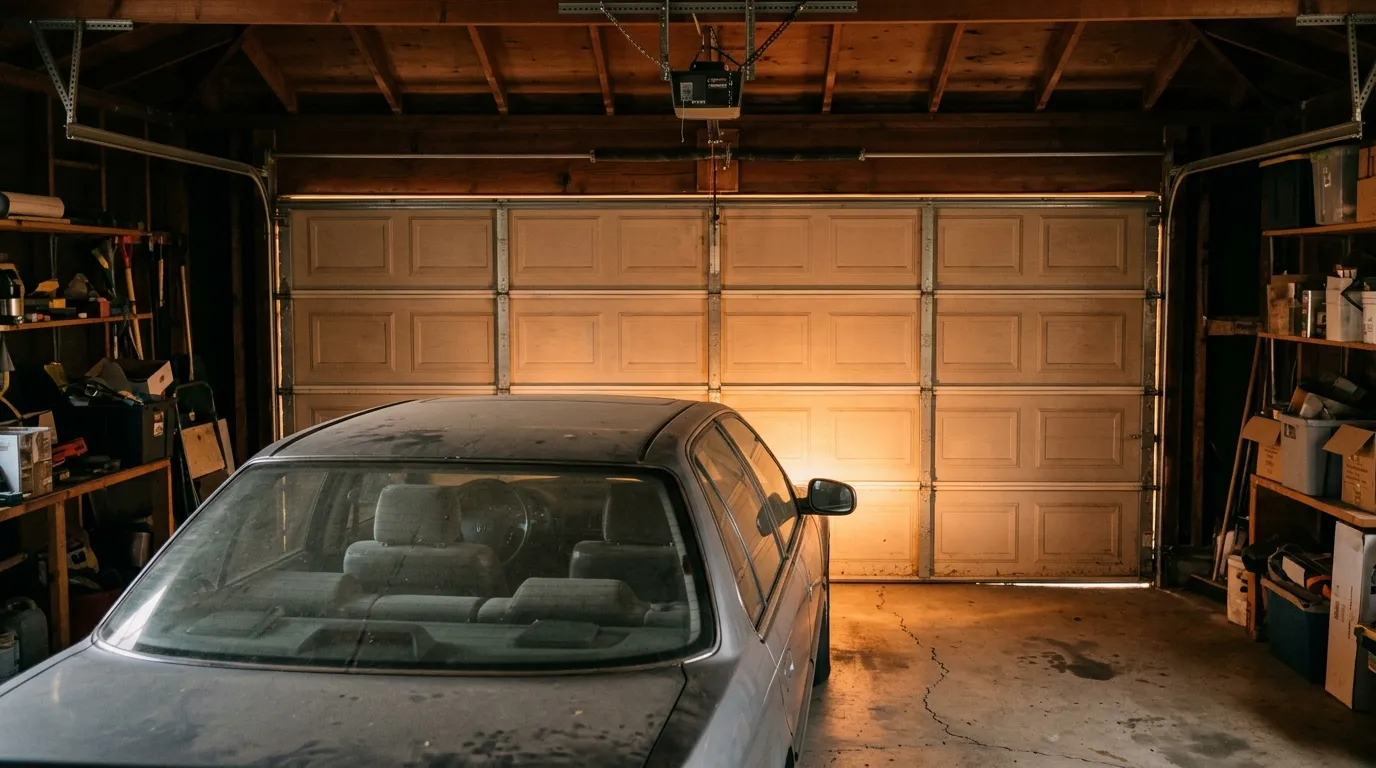
Does anything at all happen when you press the button? If the answer is nothing, check the power and the lock switch on the wall button. Then look at the spring above the door. If the coil has a gap in it, stop: do not lift the door and do not pull the red cord. That one needs a technician.
Seven causes, from the free ones to the ones that need a visit
Work down the list in order, because the first three cost nothing and take a minute each.
- No power to the opener. Safe to try. Look at the opener on the ceiling. If no light is showing, check that it is still plugged in, press the reset on any outlet with test and reset buttons in the garage, and check the breaker.
- The wall control is locked. Safe to try. Many wall buttons have a lock or vacation switch that turns off every remote and keypad. It gets pressed by accident. If the wall button opens the door and the remotes do not, this is the first suspect.
- A dead remote or keypad. Safe to try. Change the battery, stand closer and try the button built into the car. A keypad that lights up but does nothing has usually lost its code and needs reprogramming from the manual.
- The door has been disconnected from the opener. Safe to try, with the door closed. If the motor runs and the chain or belt travels but the door stays put, the red release cord has most likely been pulled. Run the opener once with the door down and the trolley normally picks the door back up. If it does not, the carriage may be broken, and that is a call.
- The opener hums or strains, and the door lifts a few inches and stops. Call. This is the mark of a broken spring. Look above the door for a gap in the coil, then leave everything alone.
- The motor runs freely and nothing moves, not even the chain. Call. A drive gear inside the opener has most likely stripped. White plastic shavings around the motor housing or on the floor beneath it point to the gear.
- The door is crooked or jammed in the tracks. Call, and stop using it. A lift cable, the wire at the side of the door, has come off or snapped, or a roller has left the track.
Causes one to four are an opener and controls problem at worst. Five and seven are about the door itself, and they are the ones where pressing the button again makes the bill bigger.
Why a straining opener points at the spring
An opener that groans and gives up is almost never a weak opener.
The springs carry the door. The motor on the ceiling is sized to guide a load that already balances, a little like pushing a child on a swing. Take the spring away and the opener is asked to lift the child, the swing and the frame.
So it tries, feels the weight and cuts out after a few inches. That protects the motor the first time. Repeated tries strip the drive gear, and then a spring repair becomes a spring repair plus an opener repair.
If you see a gap in the coil. Leave the door down. Do not press the button again, do not pull the red cord and do not try lifting it with a helper. The spring is the only part that made the door liftable, and the cables and bottom corner brackets can still be under load.
What the sound tells you
Press the button once and listen, because each kind of silence or noise narrows the list.
- Nothing, and no lights: power. Cause one. If only the remotes are dead, cause two.
- A click from the wall button or the motor, then nothing: the opener has power and is refusing to start. If the outlet and lock switch are fine, it is a job for a technician.
- A steady hum with no movement: the motor is trying against something it cannot shift, or a start capacitor in an older opener has failed. Do not hold the button.
- Normal running noise, door still: the trolley is disconnected, the carriage has broken or a gear has stripped. Causes four and six.
- A bang, earlier, that nobody could explain: that was the spring.
Two causes that follow the weather
Some doors refuse only at certain hours, and the clock is the clue.
The hot afternoon. Opener motors carry a thermal cutout that stops them when they overheat. Sacramento sees about 76 days a year at 90 degrees or above, and a closed garage runs hotter than the street.
If the door will not open at five and works again after dark, the motor cooled down. One episode is a warning. A pattern means the opener is aging or the door has grown heavy.
The cold, foggy morning. Cold thickens old lubricant and makes fatigued steel brittle. A door that was a little out of balance all summer becomes too stiff for the opener on the first cold mornings, and a spring near the end of its life tends to choose one of them to let go. If the door stopped overnight with no warning, look at the spring first.
Neither one is fixed by turning up the opener’s force setting. That hides a heavy door until something breaks.
After a power cut
When the power has been off, three things are worth checking before you assume a fault.
First, the outlet. Garage outlets are often protected by a reset button, sometimes on a different outlet on the same wall, and a surge trips it.
Second, the trolley: if anyone opened the door by hand during the outage, it is still disconnected and needs to be picked up again as in cause four. Third, the slide lock on the inside of the door, which people use while the opener is off and then forget.
If the opener has power and its lights behave strangely or the remotes will no longer program, the circuit board may have taken the surge. That is a repair, not a reset.
Getting the car out, and when not to try
You can open the door by hand only if it is fully closed and the springs and cables are sound.
In that case the red cord releases the opener and the door lifts with two hands. The full sequence, including how to lock up afterward, is in the guide to opening a garage door manually.
Do not try it when a spring is broken, a cable is loose or the door sits crooked. A door in that state weighs what it weighs, and nothing holds it up once it is raised.
Say on the call that a car is trapped. Same-day visits are available and the line is answered at any hour, and the technician can get the door open safely before starting the repair.
Symptom, cause and next step in one table
Find your row, then do only what the third column says.
| What you see or hear | Likely cause | Try yourself | Call |
|---|---|---|---|
| No lights, no sound | No power | Plug, outlet reset, breaker | If power is fine and it stays dead |
| Wall button works, remotes do not | Lock switch or remote battery | Lock switch, battery | If remotes will not reprogram |
| Motor and chain run, door still | Trolley released or carriage broken | Run opener with door closed | If it will not reconnect |
| Hum, door lifts a few inches | Broken spring | Nothing | Yes, leave the door down |
| Motor spins, chain still | Stripped drive gear | Nothing | Yes |
| Door crooked, cable loose | Cable off or snapped | Nothing | Yes, stop using it |
| Roller out of the track | Impact or loose track | Nothing | Yes, stop using it |
| Fails only on hot afternoons | Motor overheating | Let it cool | If it repeats |
| Fails on cold mornings | Stiff, unbalanced door or spring | Look for a gap in the coil | Yes, if you find one or the door feels heavy |
Which repair this turns into
The cause decides who you need, and only two of the seven are usually about the motor.
A crooked door is cable repair, and a roller out of its channel is an off-track repair. A door that opens but reverses on the way down belongs to the safety sensors, which stop a door closing and never stop it opening.
If you have reached the end of the list and the fault is in the motor, the gear or the board, the opener repair page explains what can be fixed and when a replacement makes more sense. Whichever it is, tell us what the door did and what you heard. A licensed local technician comes out, confirms the cause and gives you the price before starting.