
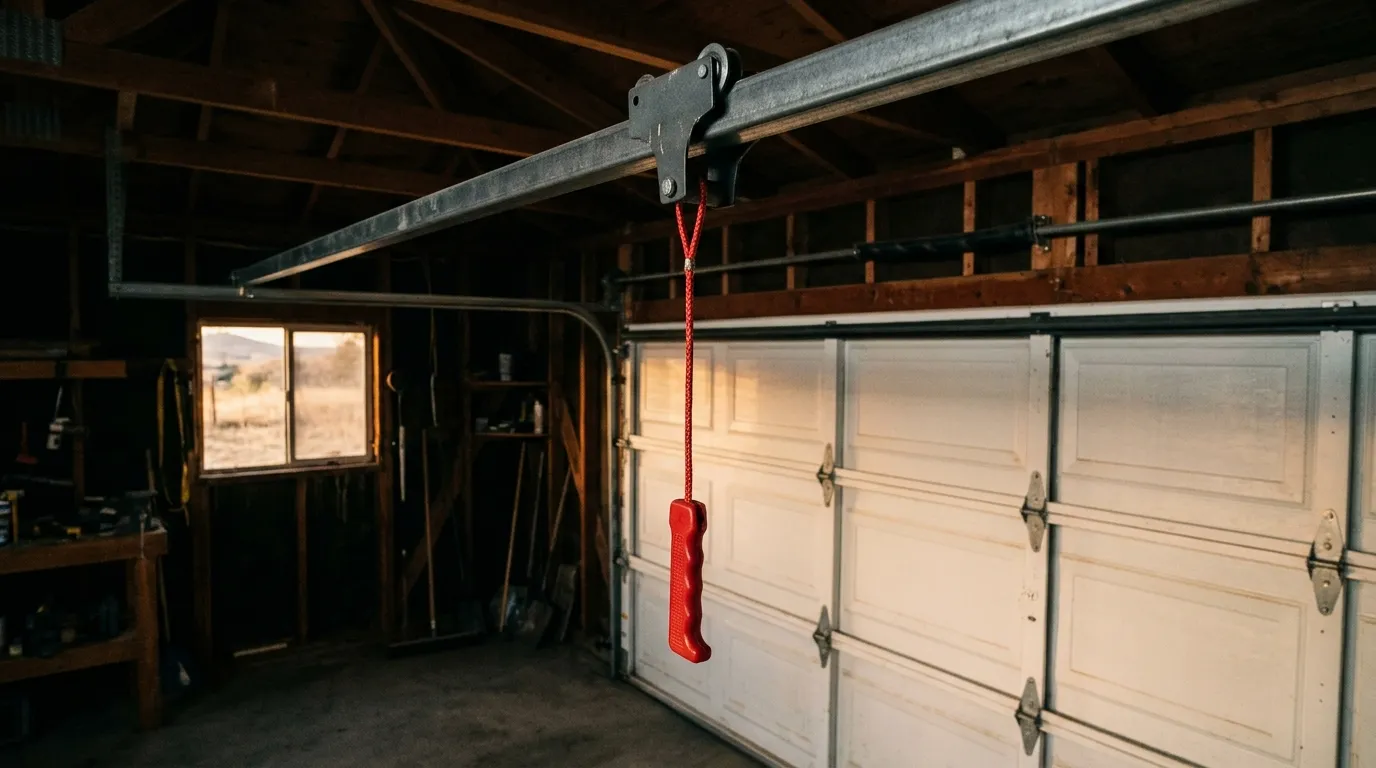
Is the door all the way down, and is the spring above it in one piece? If so, pull the red cord straight down to release the opener, then lift the door by its handle with both hands. If it feels very heavy or will not stay up, set it down and stop: a spring is broken.
Before you pull anything, look at the spring
Thirty seconds of looking tells you whether the door is safe to lift by hand.
The opener never carried the door. The springs do that, and the motor only steers. So with the power off, a door on good springs still rises easily, and a door on a broken one is a dead weight of a few hundred pounds.
Use a flashlight and check three things:
- The coil above the door. On most doors a thick spring is wrapped around a steel bar over the opening. It should be one unbroken coil. A gap of an inch or two means it has snapped.
- The springs along the side tracks. Older doors have a long spring beside each overhead track. Neither should be hanging slack.
- The cables. The lift cable is the wire running down each side of the door to its bottom corner. Both should be tight and sitting on their drums.
If any of those looks wrong, do nothing further. Do not pull the release and do not try the lift.
A door with a broken spring can drop on whoever is under it, and a loose cable lets one side fall first. Leave it closed and call. The line is answered 24 hours a day.
The sequence, from release to a locked door
With the door fully closed and the springs intact, opening it by hand is something any adult can do.
- Confirm the door is all the way down. The release is only for a closed door. If the door stopped partway when the power failed, do not pull the cord.
- Clear the path. Move the car back a little if it is close, and check that nothing is leaning on the door.
- Pull the red handle straight down. You will feel or hear the trolley, the carriage that rides the opener’s rail, let go of the door. On some openers the pull is down and slightly toward the motor.
- Lift from the handle or the bottom edge, both hands, knees bent. Raise the door smoothly until it rests in the overhead tracks. Keep your fingers away from the joints between sections.
- Let go slowly and watch it. A healthy door stays up. If it starts to sink, lower it by hand and stop there. Do not hold it up with a ladder or a length of wood.
- Drive out, then bring the door down by hand. Lower it under control all the way to the floor. Do not let it drop the last foot.
- Lock it. A released door is not held shut by the opener any more. Slide the lock bar on the inside if the door has one, or leave by the house door and keep the garage door within sight.
If the door fights you at step 4, that is your answer. Set it down and treat it as a spring problem.
One-piece doors swing outward
A door made of a single slab moves differently, and the difference matters when you are standing in front of it.
A sectional door travels straight up and rolls back along the ceiling. A one-piece door, found on some older garages, pivots. The bottom edge kicks out toward the driveway as the top goes in.
Stand to the side, not in front. Check that no car is parked within the swing. These doors run on large springs at each side, and if either one is stretched out, hanging or broken, leave the door alone and read the tilt-up door page.
Getting in from outside when the garage has no other door
A garage with no side door and no door into the house needs a keyed release, and the time to find out whether you have one is before the outage.
Look near the top center of the door from outside for a small round lock. That is an emergency release, and like the red cord it is only for a door that is fully closed.
Turn the key and draw the lock cylinder out, and a thin cable attached to it trips the same release the red cord does. Then lift the door from the outside handle.
You cannot inspect the springs from the driveway, so let the weight tell you. If a firm two-handed lift does not move the door, or it rises and wants to drop, set it down and stop. That is a broken spring, and the door stays closed until a technician has seen it.
Detached garages and garages that open onto an alley are the ones that most often have no second way in. If yours has no keyed release, a technician can add one. It is a small job to do alongside a tune-up or a new opener.
Reconnecting the opener when the power returns
The trolley has to be joined to the door again before the opener will move it.
Start with the door fully closed and the slide lock open. Running an opener against a locked door bends the top section and can strip the drive gear, and it is an easy mistake to make after an outage.
On most openers, pressing the wall button is enough. The trolley travels along the rail, meets the arm on the door and clicks back in.
Some designs need the red cord pulled toward the door first to reset the latch. If yours does not catch after one full run, check the manual before trying again.
Then run the door through a full open and close and watch that it stops where it should. If the opener is silent, a tripped outlet or breaker is the usual reason, and the checklist for a door that will not open starts there.
Why this is worth knowing before the next storm
Outages here come with winter wind, and they last long enough to trap a car.
In January 2023, a run of storms that SMUD called the most damaging in its history cut power to 599,000 customers and brought down more than 300 poles. On February 4, 2024, winds above 65 mph put about 200,000 customers out at the peak.
Heat does it too. On September 6, 2022, the day Sacramento reached its record of 116 degrees, SMUD asked customers to conserve power and warned that shortfalls could lead to rolling outages. A garage door that will not open is a small problem until the car you need is behind it.
What California law says about battery backup
Newer openers are required to carry a battery so that the door still works in an outage.
Health and Safety Code section 19892. Every residential garage door opener sold or installed in California since July 1, 2019 must have a battery backup that operates during an electrical outage. A replacement garage door may not be connected to an existing opener that lacks one. Nothing in the section requires you to replace an older opener that still works.
To find out whether yours has one, look at the motor housing for a battery compartment or a battery status light, or look up the model number. To test it, unplug the opener from the ceiling outlet and press the wall button. A good battery runs the door, usually more slowly than normal.
Backup batteries wear out like any other. How long one lasts and how many cycles it gives during an outage are in the manual for your model, so check there and not on a forum.
What you find, and what to do about it
Most outage situations sort into one of five cases.
| What you find | What it means | What to do |
|---|---|---|
| Door closed, springs and cables look right | Safe to release | Follow the seven steps |
| Gap in the coil, slack spring or loose cable | The counterbalance has failed | Leave it closed and call |
| Door stopped partway when the power cut | The opener is holding it | Do not release; keep clear and call |
| Door lifts but will not stay up | Springs are worn | Lower it; have the balance checked |
| No way in from outside, no keyed release | The door cannot be reached | Call; a release can be fitted afterward |
If the door will not move by hand and the car has to come out tonight, say so when you call. Emergency garage door repair is available around the clock, and the technician secures the door before doing anything else.