
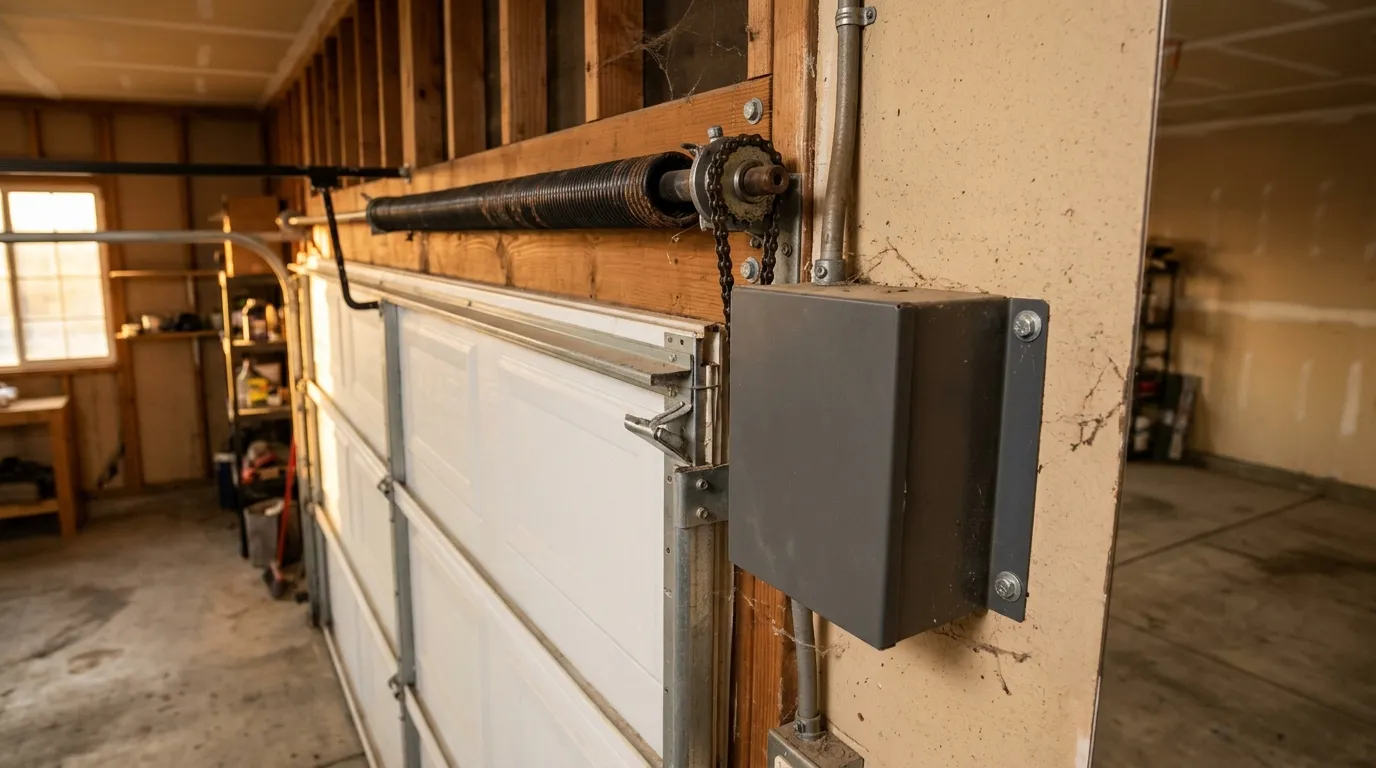
What is above your door: a steel bar with a coiled spring on it, or only ceiling? A side mount garage door opener bolts to the wall beside the door and turns that bar directly. It suits low or crowded ceilings and tall doors. It needs a sectional door with a torsion spring, some wall space and an outlet.
How a jackshaft opener moves the door
A wall-mount opener turns the shaft the door already hangs from. It does not pull the door along a rail.
The trade name is jackshaft opener. On a sectional door, a steel shaft runs across the top of the opening. The torsion spring is wound around it, and a grooved drum at each end winds up the lift cable, the wire that runs down to each bottom corner of the door.
Turn the shaft one way and the cables wind on, so the door rises. Turn it the other way and they pay out, so the door comes down under its own weight. A jackshaft unit slides over the end of that shaft and does the turning.
The spring still does the lifting, as it does with every opener. That is why this kind of opener is so dependent on the door being in good order. It has no rail and no arm to push with.
What it needs before it can go in
Four things have to be true of the garage, and a technician checks all of them before quoting.
A sectional door
Hinged sections that roll up on tracks. A single slab will not work.
A torsion spring
The coil on the bar above the door, with the bar reaching past its end bracket.
Wall beside the door
Clear space on one side for the unit, free of pipes, panels and shelving.
An outlet nearby
Most garages have theirs in the ceiling, where the old opener plugged in.
A fifth condition is harder to see: the door has to be balanced and free in its tracks. A tune-up before the installation settles that, and tired springs are replaced first, not left for the new opener to struggle against.
The outlet is the item people forget. If there is none within reach of the unit’s cord, one has to be added, and new wiring is electrical work that can need a permit. Ask your building department before the day of the installation.
What it cannot drive
A jackshaft opener cannot run a one-piece door, and it cannot run a door on extension springs without a conversion.
- One-piece doors. The slab that swings out and up has no shaft and no drums, so there is nothing to turn. These are covered on the tilt-up door page, and a rail opener or a new sectional door is the route.
- Extension-spring doors. Springs stretched along the overhead tracks pull through pulleys, with no shaft to drive. The door can be converted to torsion springs first, which adds to the job.
- A door that binds. A rail opener pushes the door shut. A jackshaft only lets the cables out and relies on the door to follow. If a roller sticks, the door stops and the cables go slack.
- A badly balanced door. Any opener suffers on one. This kind shows it soonest.
Two extra parts you will see on the wall
Wall-mount units usually come with a cable-tension monitor and an automatic deadbolt, and both exist because there is no rail.
The cable-tension monitor is a small sensor resting against one lift cable. If the door catches on the way down and the cable loosens, the sensor stops the motor before the cable can jump off its drum. Where the unit comes with one, it is fitted as part of the installation and not left in the box.
The deadbolt answers a different gap. A rail opener holds a closed door shut through its arm.
A jackshaft has no arm, so a powered bolt slides through the track each time the door closes and draws back before it opens. You will hear it click.
Side mount, belt or chain
The three differ most in where they sit, how loud they are and which doors they accept.
| Compared on | Side mount (jackshaft) | Belt drive on a rail | Chain drive on a rail |
|---|---|---|---|
| Where it sits | Wall beside the door | Ceiling, center of the garage | Ceiling, center of the garage |
| Noise | Quietest in the house | Quiet | Loudest |
| Ceiling space | Left clear | Rail and motor take the middle | Rail and motor take the middle |
| Doors it drives | Sectional with torsion spring | Sectional, and one-piece with the right arm | Sectional, and one-piece with the right arm |
| Price | Top of the range or above | Middle | Lowest |
| Battery backup | Required on new units in California | Required on new units in California | Required on new units in California |
| Extra parts | Tension monitor, deadbolt | None | None |
When a rail opener is the better buy
For an ordinary garage with a normal ceiling and nothing stored overhead, a belt-drive rail opener does the same job for less.
Choose the rail opener when the door runs on extension springs and is otherwise sound, when the wall beside the door is taken by a water heater or an electrical panel, or when the budget is the deciding factor. A belt drive is already quiet enough for a bedroom above.
Choose the wall unit when something real is in the way. That means a ceiling too low for a rail, a tall door on high-lift track that climbs the wall before turning back, a storage rack or car lift overhead, or a finished ceiling you do not want a motor hanging from.
Low ceilings in older garages
The garages that most need a wall-mount opener are often the ones least ready for it.
Much of central Sacramento was built before openers were standard. In the 95818 ZIP code, which takes in Land Park and Curtis Park, the median home dates from 1942, and in East Sacramento’s 95819 it is 1950. A garage of that age can be short on headroom, the space between the top of the door and the ceiling.
A jackshaft solves the headroom problem only if the door is sectional with a torsion spring. A door original to those decades may be one-piece, and that kind has to be replaced before a wall unit can be considered. The honest order is to settle the door first and the opener second.
Heat is a smaller point in favor. The hottest air in a summer garage collects under the roof, and a wall unit sits below it. Nobody has measured what that does for an opener’s electronics, so count it as a consideration and not a reason.
The rule every new opener has to meet
Whichever type you choose, California requires it to work when the power is off.
Battery backup. Under Health and Safety Code section 19892, any residential garage door opener sold or installed in California since July 1, 2019 must have a battery backup that operates in an outage. Wall-mount and rail openers are treated alike.
Installing an opener is licensed work in the same way a door is. The Contractors State License Board files it under class C-61, subcategory D-28, and a license is required once a job reaches $1,000 or needs a permit. A wall-mount installation with an added outlet can meet both tests.
What a wall-mount opener costs
Expect a wall-mount unit to sit at or above the top of the published range for openers.
Fixr’s national guide, updated January 31, 2025, puts opener replacement at $300 to $940. HomeGuide’s 2026 guide puts a new opener, installed, at $300 to $900. Neither separates wall-mount units, which generally cost more than chain and belt models.
No verified local average exists, so the number that counts is the written quote. It should list the unit, the tension monitor and deadbolt, any outlet work and any spring or conversion work, each as its own line. The estimate is free.
What the installation involves
A proper installation starts with the door and reaches the opener last.
- Tests the balance. With the old opener disconnected, the door should stay where it is stopped. If it does not, the springs are dealt with first.
- Checks the shaft, drums and cables. The unit grips the shaft, so the shaft and its bearings have to be sound.
- Mounts the unit and couples it to the shaft.
- Fits the cable-tension monitor and the deadbolt.
- Wires the safety sensors and the wall control.
- Sets the travel limits and force, then proves the door reverses on an obstruction and when the sensor beam is broken.
If the old rail opener still works and you only want the ceiling clear, say so.
If it has failed, the opener repair page covers what can still be fixed. To find out whether your door qualifies, book an opener installation visit. A licensed local technician looks at the shaft, the wall and the outlet and tells you which type fits before quoting either.