
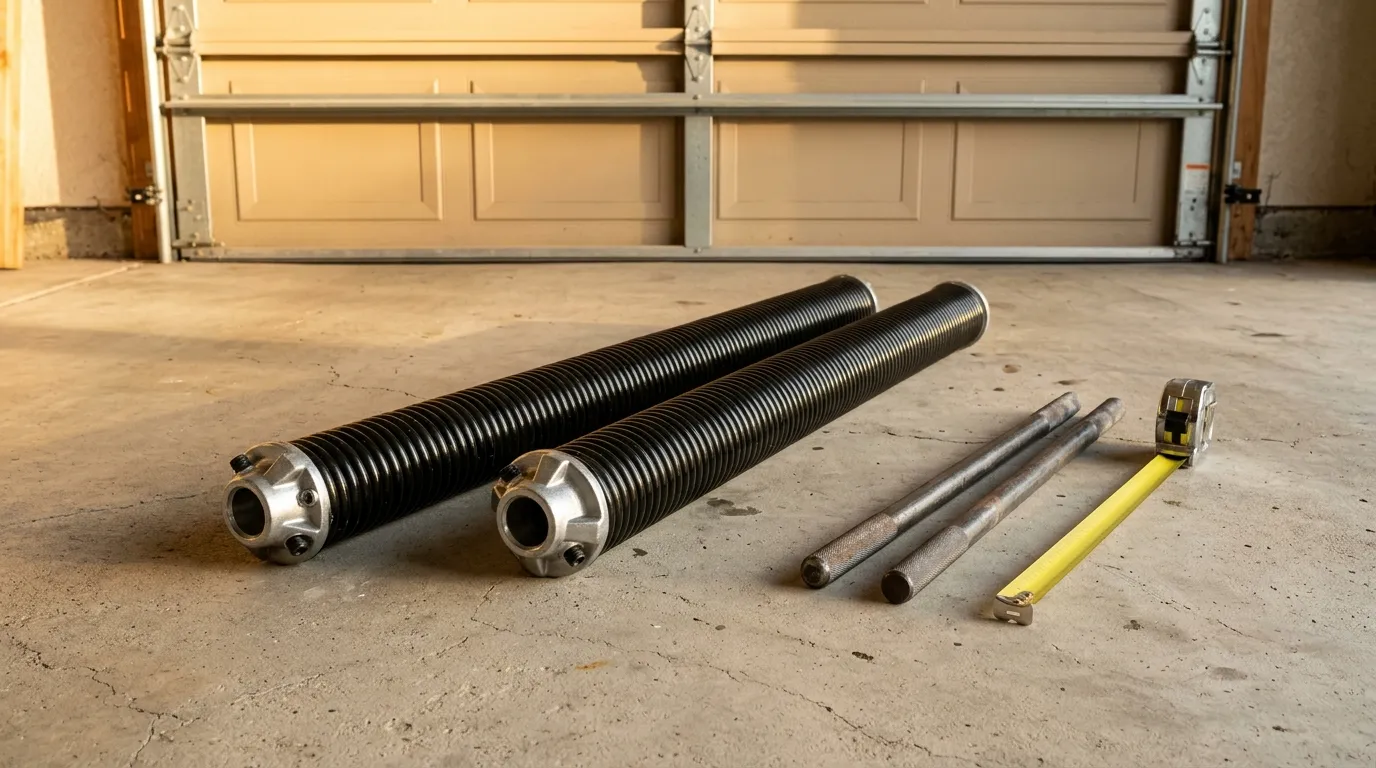
One spring above the door, or two? Published national figures put garage door spring replacement cost at $200 to $350 for a pair of torsion springs and $120 to $250 for extension springs (Fixr, updated January 31, 2025). Those are not our prices. The technician’s written quote on site is the number that counts.
What the published guides say, side by side
Two national cost guides land close together, and neither one is a local price list.
| Spring type | Fixr (updated January 31, 2025) | HomeGuide (2026) |
|---|---|---|
| Torsion springs, both replaced | $200 to $350 | $150 to $350 |
| Extension springs | $120 to $250 | $120 to $200 for both |
Fixr notes that torsion springs are virtually always replaced as a pair, which is why neither guide leads with a single-spring price.
We looked for a verified average for Sacramento alone and did not find one we could stand behind, so there is none on this page. Use these numbers to judge a quote, then let the spring repair visit produce the real one. The estimate is free.
Which spring you have sets the starting point
Torsion springs sit at the higher end because there is more steel in them and more work in fitting them.
A torsion spring is the thick coil wrapped around the steel bar across the top of the opening. It stores the door’s weight by twisting as the door comes down. Most two-car doors, and most doors hung in recent decades, have one or two of them.
Extension springs are the long, thinner springs beside the overhead tracks, and they stretch instead of twisting. You find them on older and lighter single doors. A one-piece door, the single slab that swings out and up, uses a heavier version at each side, and the tilt-up door page explains how those differ.
A few doors hide the spring inside the bar, so the door looks as if it has no spring at all. Those take different parts, and a phone price for an ordinary spring will not apply to them.
Six things that move the number
The door decides the spring, and the spring decides most of the price.
| What changes | Toward the low end | Toward the high end |
|---|---|---|
| Spring system | Extension springs | Torsion springs |
| How many | One spring on a light single door | A pair on a two-car door |
| Door weight | Single, uninsulated steel | Double, insulated or solid wood |
| Spring grade | Standard, about 10,000 cycles | High-cycle, 25,000 or more |
| Time of the visit | Weekday working hours | Night, weekend or holiday |
| Parts found worn on site | None | Cables, bearings or drums |
Weight matters more than people expect. A heavier door needs thicker wire and a longer coil, and that is a different part with a different price, not the same spring wound tighter.
The last row is the one that surprises people. The lift cable, the wire that runs down each side of the door, is often frayed by the time a spring gives out, and a worn cable is cheapest to change while the shaft is already apart.
Why the quote is usually for both springs
A two-spring door gets two new springs because the survivor is exactly as old as the one that broke.
Every time the door opens and closes, both springs flex once. They were fitted on the same day, so they reach the end of their rated life within weeks or months of each other. Replacing one is like changing a single wiper blade: it works, and you will be back soon for the other.
There is also the balance. A spring loses some of its pull as it ages, so a fresh spring paired with a tired one shares the load unevenly. A matched pair lets the technician set the door so it stays wherever you stop it.
You can still ask for one spring. A fair technician will price it both ways and let you choose.
How a low phone quote grows in the driveway
A price given before anyone has seen the door is a guess, and a very low one is usually a guess with things left out.
The pattern is familiar. The phone price covers one basic spring, and once the truck is outside the bill gains a second spring, a heavier grade, a hardware kit and a service fee.
Sometimes that is honest, because a spring cannot be sized from a description. The difference is whether you were told so before anyone drove over.
A written quote worth signing lists these, each on its own line:
- The spring type, how many, and whether they are standard or high-cycle
- Labor
- Any service or trip charge, and whether it is dropped when you go ahead
- Every additional part, with the reason it is needed
- Any surcharge for the hour or the day
- The total, written down before a tool comes out
If a part other than the spring is on the list, ask to be shown the wear. A frayed cable or a gritty bearing is easy to point at.
Why doing it yourself saves less than it looks
The spring is only part of the bill. The rest pays for the sizing and the winding.
Not a weekend project. A torsion spring is wound with solid steel bars until it holds enough torque to raise the whole door. If a bar slips, or something else is used in its place, that force comes back through the hands and face of whoever is holding it. We do not publish the steps.
Sizing is the quieter problem. A spring is specified by its wire thickness, inside diameter, length and the direction it is wound, all matched to what the door weighs. One that is close but not right gives you a door that creeps down or jumps up, and an opener that wears out early doing work the spring should do.
So the saving on a mail-order spring is real on the receipt and often gone within a year or two.
How long the new springs should last
A standard spring is rated for about 10,000 cycles, which for most households works out to seven to ten years.
One cycle is one opening and one closing, so every errand costs a cycle. A door opened three times a day uses its 10,000 in about nine years. Eight times a day, which is ordinary when the garage is the family entrance, uses them in under four.
That arithmetic is the whole case for a high-cycle spring. It costs more, and it is rated for 25,000 cycles or more.
Two habits help either kind. A light coat of garage-door lubricant on the coil twice a year keeps rust from grinding between the turns, and a yearly tune-up catches a door that has drifted out of balance before the spring pays for it.
Check the license before you say yes
California licenses this trade, and a spring job often falls just below the line where a license becomes mandatory.
The $1,000 rule. Garage door work belongs to the Contractors State License Board’s C-61 limited specialty class, under D-28, Doors, Gates and Activating Devices. A license is required for any job of $1,000 or more. Below that, it is still required if the work needs a permit or the person employs anyone on it (CSLB Industry Bulletin 24-07, in effect since January 1, 2025).
By the published ranges above, a pair of springs comes in well under $1,000. That means an unlicensed person may legally advertise for the job, provided the advertisement says they are not licensed.
So ask for the license number before anyone drives over, and look it up on the CSLB website.
Why so many springs here are due in the same years
Springs wear out by the cycle, and whole neighborhoods here started counting in the same decade.
Census figures show 72.3 percent of the housing in the 95835 ZIP code, North Natomas, went up between 2000 and 2009. A standard builder spring fitted in those years has been flexing for around two decades.
So if yours went with a bang last night, it is not bad luck. Leave the door down, do not run the opener, and call.
A licensed local technician looks at the door, writes the price for replacing the springs and starts only when you agree. For every other repair, the job-by-job cost guide has the published ranges.