
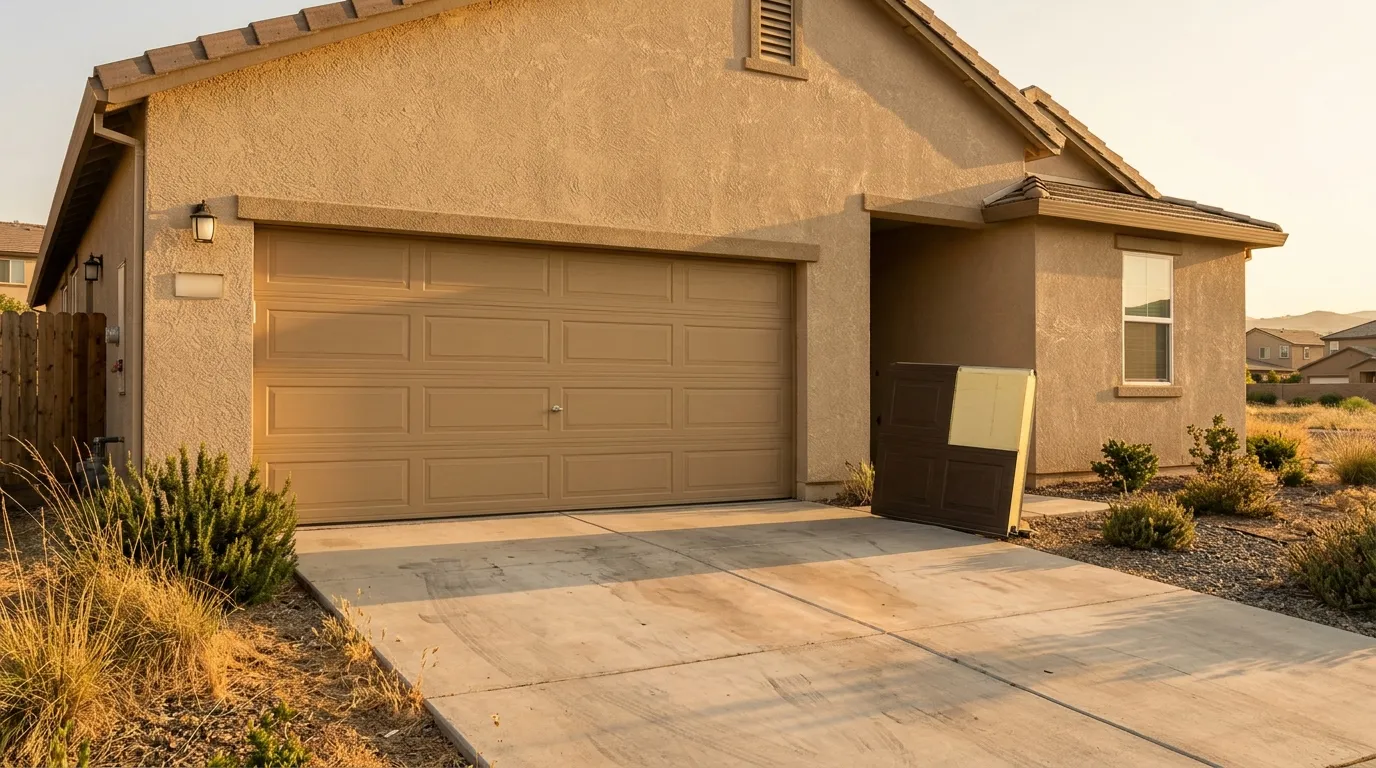
Is there a room on the other side of the garage wall, or above the ceiling? If so, an insulated garage door is worth it. The same goes for a door that faces south or west, or a garage you work in. For a detached garage that only stores things, the extra money usually buys very little.
Who gets something from an insulated door, and who does not
The door earns its price when heat coming through it reaches a place where people spend time.
Worth paying for
- An attached garage sharing a wall with the kitchen or a bedroom
- A bedroom or office built over the garage
- A door that takes direct afternoon sun
- A workshop, gym or laundry in the garage
- A household bothered by door noise
Usually not worth the extra
- A detached garage used for storage
- A garage with open eaves or large gaps at the door
- A carport enclosed on three sides
- A door on the shaded north side of a detached building
If you are choosing a new garage door anyway, the question is only how much insulation to buy. If your present door works, the question is harder, and the rest of this page is for you.
Why the question keeps coming up here
A single sheet of steel in full sun is a radiator pointed into your garage.
Sacramento averages 76 days a year at 90 degrees or above, and 14 of those reach 100. A west-facing door spends each of those afternoons soaking up sun, and an uninsulated one hands the heat straight through. Touch the inside of the door at five o’clock and you will feel it.
The nights are the other half. July nights average about 33 degrees cooler than July afternoons, helped by the breeze that comes up through the Delta.
An insulated door slows the heat getting in by day, and opening the garage in the evening lets the stored heat out. The two work together.
What R-value tells you, and what it leaves out
R-value measures how well a material resists heat passing through it, and a higher number means slower heat flow.
That is all it measures. Each manufacturer publishes its own figures, tested its own way, so the numbers are only safe to compare within one brand’s range. Some describe the middle of a section and not the whole door with its joints, edges and windows.
We are not quoting R numbers here for that reason. Ask for the figure from the maker’s own page for the exact model, and compare it with that maker’s other doors.
The larger point is that the door is one surface. A garage with a bare roof deck overhead takes more heat from above than through the door. A door with a cracked bottom seal lets hot air in under any amount of foam.
Insulation works as a set: door, weather seals, ceiling, and the wall shared with the house.
How the layers are built
Garage doors come in three constructions, and the number of layers tells you most of what you need to know.
| Construction | What it is made of | How it behaves |
|---|---|---|
| Single-layer | One steel skin, ribs showing on the inside | Light, loud, dents easily, no resistance to heat |
| Two-layer | Steel skin, foam board, thin vinyl backing | Insulated and still light; the backing marks easily |
| Three-layer | Steel, foam, steel | Stiffest, quietest, heaviest; the foam is protected on both faces |
The foam is one of two kinds. Polystyrene is rigid board, cut to size and set into the section. Polyurethane is injected as liquid foam that expands and bonds to the steel, so it fills every corner and adds stiffness as well as insulation.
For the same thickness, polyurethane insulates better. That matters on a garage door, because the thickness is fixed by the track and hardware.
What changes besides the temperature
An insulated door is stiffer, quieter and heavier, and the third of those is the one that involves the springs.
Stiffness shows up as dent resistance and as sections that do not flex and rattle as the door moves. Quiet follows from that. A three-layer door closes with a thud where a single skin clatters, which you notice most from a bedroom over the garage.
Weight is the catch. The springs carry the door, and they are sized to what it weighs. A heavier door on springs chosen for a lighter one drifts down, feels heavy by hand and makes the opener strain.
On a new door the installer supplies springs to match, so it is handled. It becomes your problem only when weight is added to an old door.
Retrofit kits, and the catch with balance
A kit of foam or foil panels helps a single-layer door, though less than a factory-insulated door does, and it changes the door’s weight.
Kits press or tape into the back of each section between the ribs. They cut the radiant heat coming off the steel and they quiet the door a little. They do not seal the joints between sections, and they add no stiffness.
They do add pounds, and the springs were not chosen for them. After fitting a kit, watch for a door that no longer stays where you stop it, or an opener that sounds as if it is working harder. Either one means the balance is off, and a tune-up visit is the place to have it corrected.
Leave the springs to a technician. Adding weight to the door is safe. Adjusting the springs to carry it is not. They are wound with enough force to lift the whole door, and the adjustment is done with steel bars by someone trained to hold them.
The winter side of the same door
Insulation works in both directions, and the foggy months make their own case for it.
Valley fog between November and March keeps the days cold and the air damp. A bare steel door goes as cold as the air outside, and moisture from a warmer garage condenses on the inside face. A three-layer door stays closer to the temperature of the garage, so tools and stored boxes stay drier.
The steel inner face matters here too. It keeps damp air and the occasional bicycle handlebar away from the foam.
What it costs, and what we will not claim
Insulation adds to the price of a door, and no verified figure exists for what it saves on a power bill.
HomeGuide’s 2026 guide puts a new door, installed, at $700 to $2,700 for a single and $1,000 to $3,500 for a double. Those are published figures, not our prices. The technician measures the opening and quotes the actual door, and that estimate is free.
You will see energy-saving percentages in advertisements. We could not trace any of them to a source we could read, so this page gives none. A garage is not usually heated or cooled, and what you gain is comfort in the rooms beside it.
Rules that come with a new door in California
A new door brings one state rule with it, and sometimes a neighborhood one.
The opener rule. Under Health and Safety Code section 19892, a replacement garage door may not be connected to an existing opener that has no battery backup. If your opener predates July 2019 and lacks one, plan for a new opener with the door.
Appearance rules exist in places. In the South Land Park Hills Eichler district, the city’s plan calls for a plain flat-surface door, not a raised-panel one, where the original cannot be kept. Flush insulated doors are made, so the two aims can be met together.
Permit rules are for the building department to state. Ask before ordering, especially if the opening is being widened or new wiring is going in.
A quick way to decide
Match your garage to a row.
| Your garage | Verdict | Reason |
|---|---|---|
| Attached, shares a wall with living space | Yes | Heat through the door reaches the house |
| Room above the garage | Yes, three-layer | Comfort and noise both improve |
| Door faces south or west | Yes | It takes the afternoon sun directly |
| Workshop or gym inside | Yes | You are in there at the hottest hours |
| Detached, storage only | Usually no | Nothing nearby benefits |
| Old door with a failed bottom seal | Seal first | Air leaks defeat insulation |
If the row says yes, the next step is a measurement and a written price for an insulated door fitted to your opening. If only one section is damaged, look at panel replacement before deciding on a whole door.